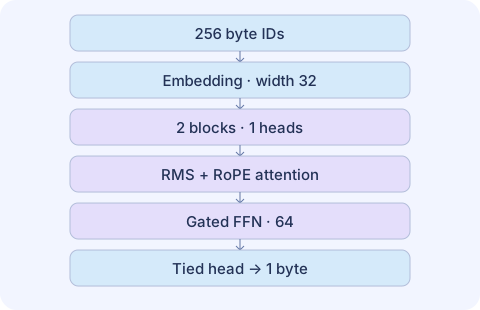
Dense autoregressive
ASI200-001
28,896 parameters · Floating-point projections
Width 32 · 2 layers · 1 heads
Index — not quality-qualified
Diagram · description · code · screen results →MODEL GALLERY / ARCHITECTURES • CODE • EXPERIMENTS
Inspect every network’s diagram, description, dimensions, complete model code and measured results. Select a model to open its research record.
200 models · all unranked pending sufficient quality evidence
28,896 parameters · Floating-point projections
Width 32 · 2 layers · 1 heads
Index — not quality-qualified
Diagram · description · code · screen results →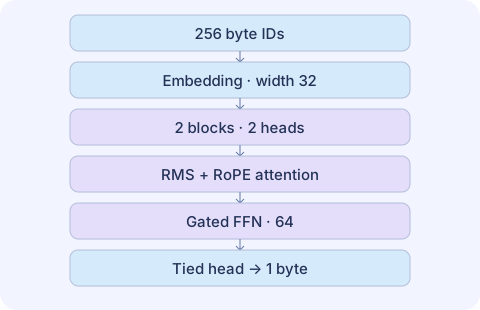
28,896 parameters · Floating-point projections
Width 32 · 2 layers · 2 heads
Index — not quality-qualified
Diagram · description · code · screen results →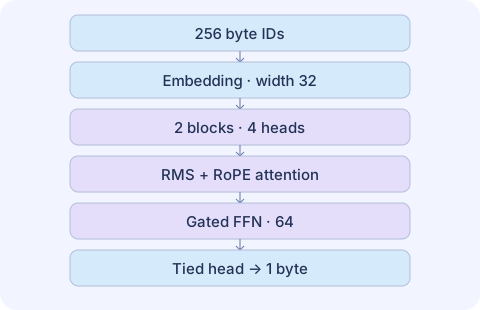
28,896 parameters · Floating-point projections
Width 32 · 2 layers · 4 heads
Index — not quality-qualified
Diagram · description · code · screen results →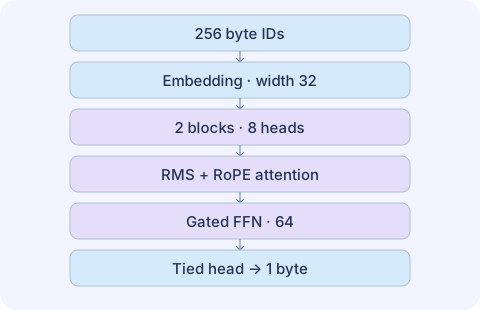
28,896 parameters · Floating-point projections
Width 32 · 2 layers · 8 heads
Index — not quality-qualified
Diagram · description · code · screen results →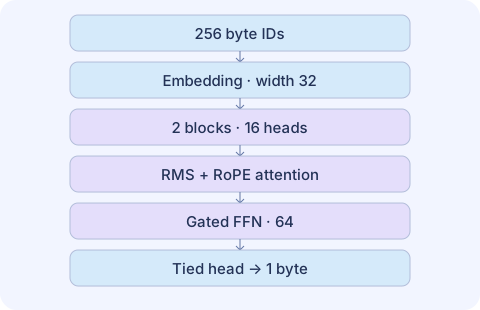
28,896 parameters · Floating-point projections
Width 32 · 2 layers · 16 heads
Index — not quality-qualified
Diagram · description · code · screen results →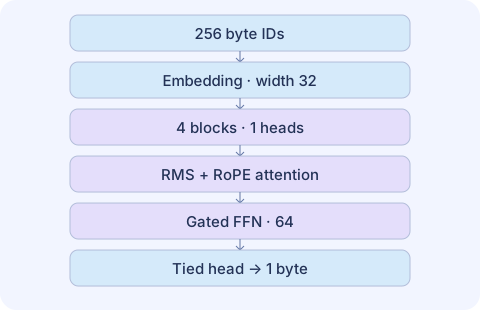
49,568 parameters · Floating-point projections
Width 32 · 4 layers · 1 heads
Index — not quality-qualified
Diagram · description · code · screen results →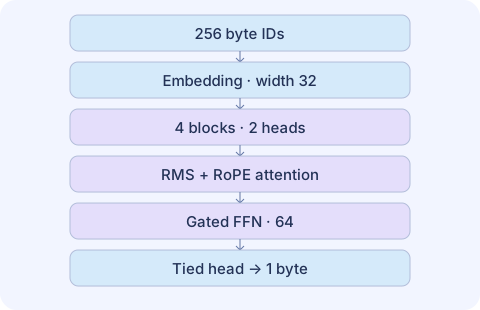
49,568 parameters · Floating-point projections
Width 32 · 4 layers · 2 heads
Index — not quality-qualified
Diagram · description · code · screen results →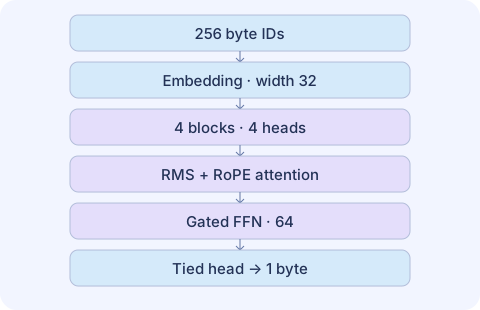
49,568 parameters · Floating-point projections
Width 32 · 4 layers · 4 heads
Index — not quality-qualified
Diagram · description · code · 3-seed curves →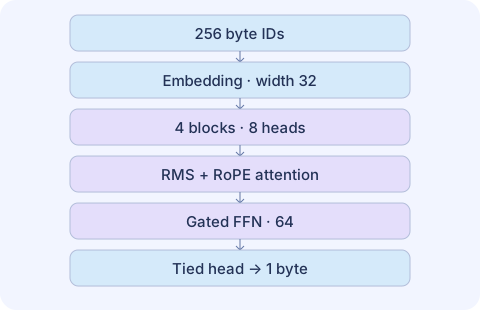
49,568 parameters · Floating-point projections
Width 32 · 4 layers · 8 heads
Index — not quality-qualified
Diagram · description · code · screen results →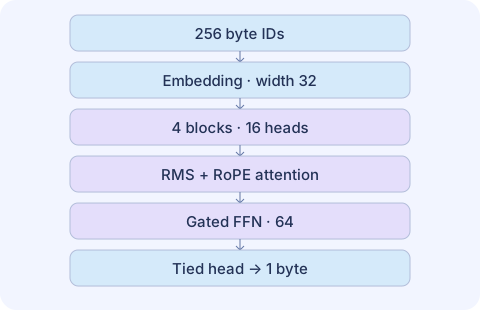
49,568 parameters · Floating-point projections
Width 32 · 4 layers · 16 heads
Index — not quality-qualified
Diagram · description · code · screen results →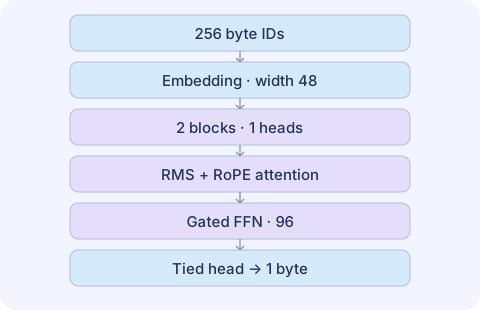
58,704 parameters · Floating-point projections
Width 48 · 2 layers · 1 heads
Index — not quality-qualified
Diagram · description · code · screen results →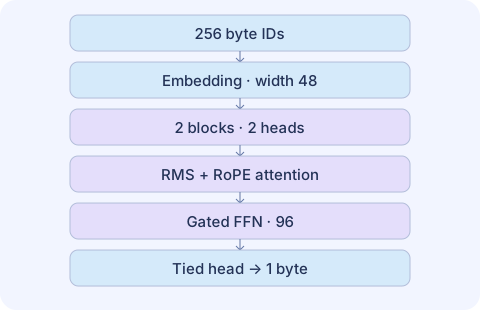
58,704 parameters · Floating-point projections
Width 48 · 2 layers · 2 heads
Index — not quality-qualified
Diagram · description · code · screen results →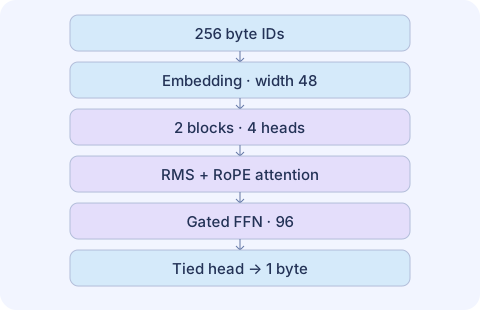
58,704 parameters · Floating-point projections
Width 48 · 2 layers · 4 heads
Index — not quality-qualified
Diagram · description · code · screen results →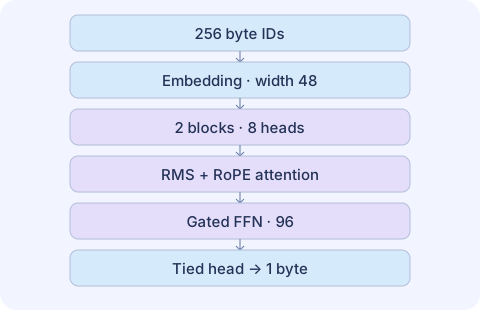
58,704 parameters · Floating-point projections
Width 48 · 2 layers · 8 heads
Index — not quality-qualified
Diagram · description · code · screen results →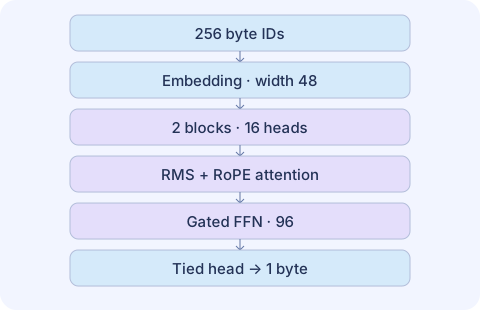
58,704 parameters · Floating-point projections
Width 48 · 2 layers · 16 heads
Index — not quality-qualified
Diagram · description · code · screen results →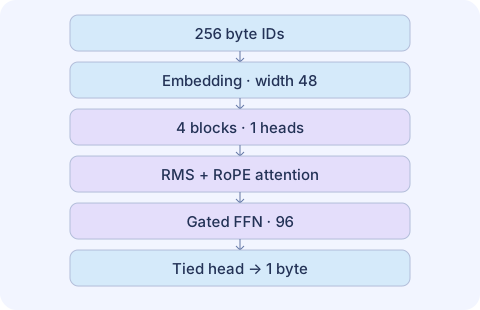
105,072 parameters · Floating-point projections
Width 48 · 4 layers · 1 heads
Index — not quality-qualified
Diagram · description · code · screen results →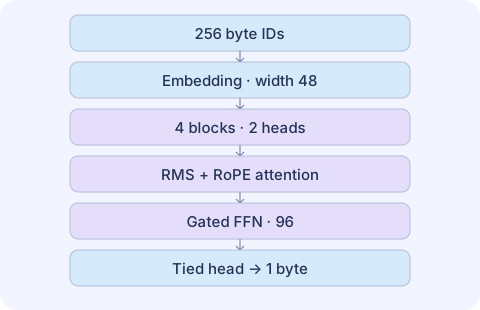
105,072 parameters · Floating-point projections
Width 48 · 4 layers · 2 heads
Index — not quality-qualified
Diagram · description · code · screen results →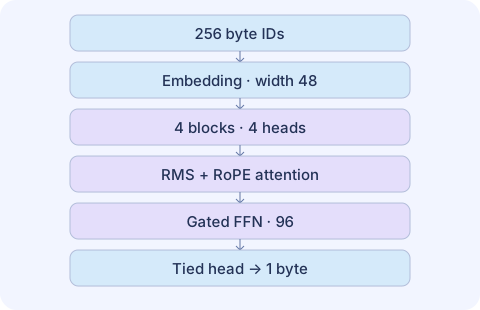
105,072 parameters · Floating-point projections
Width 48 · 4 layers · 4 heads
Index — not quality-qualified
Diagram · description · code · screen results →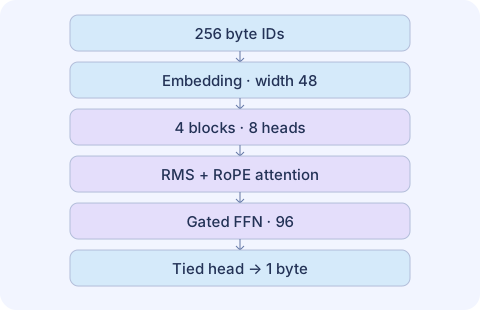
105,072 parameters · Floating-point projections
Width 48 · 4 layers · 8 heads
Index — not quality-qualified
Diagram · description · code · screen results →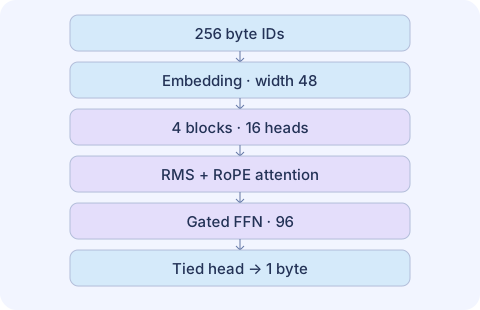
105,072 parameters · Floating-point projections
Width 48 · 4 layers · 16 heads
Index — not quality-qualified
Diagram · description · code · screen results →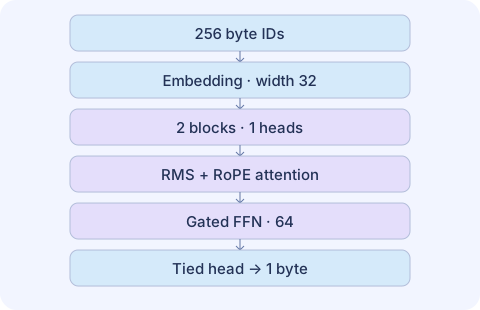
28,896 parameters · STE binary projections
Width 32 · 2 layers · 1 heads
Index — not quality-qualified
Diagram · description · code · screen results →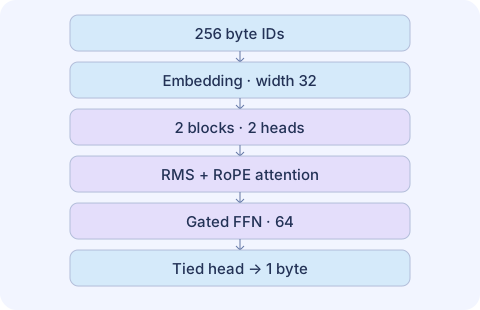
28,896 parameters · STE binary projections
Width 32 · 2 layers · 2 heads
Index — not quality-qualified
Diagram · description · code · screen results →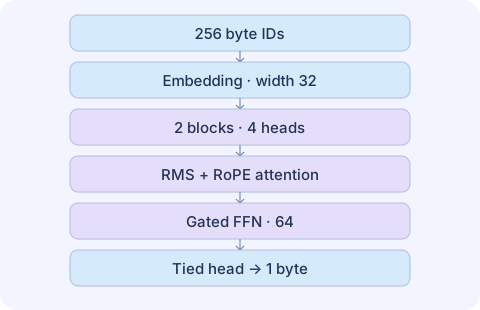
28,896 parameters · STE binary projections
Width 32 · 2 layers · 4 heads
Index — not quality-qualified
Diagram · description · code · screen results →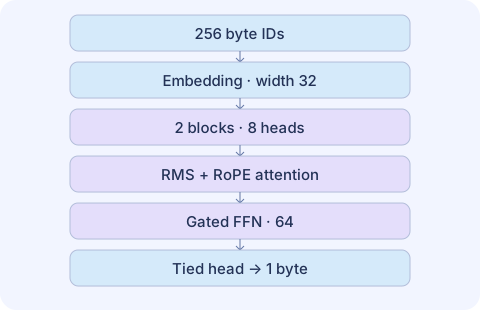
28,896 parameters · STE binary projections
Width 32 · 2 layers · 8 heads
Index — not quality-qualified
Diagram · description · code · screen results →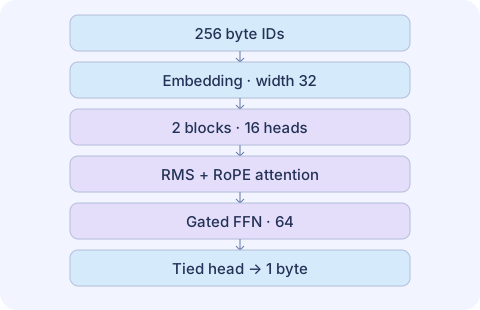
28,896 parameters · STE binary projections
Width 32 · 2 layers · 16 heads
Index — not quality-qualified
Diagram · description · code · screen results →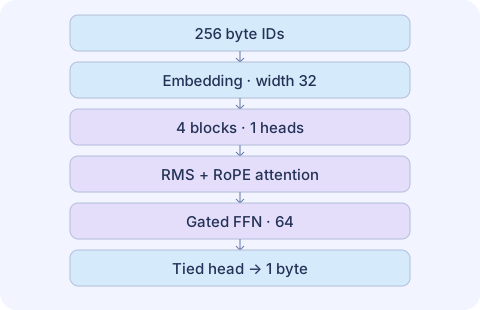
49,568 parameters · STE binary projections
Width 32 · 4 layers · 1 heads
Index — not quality-qualified
Diagram · description · code · screen results →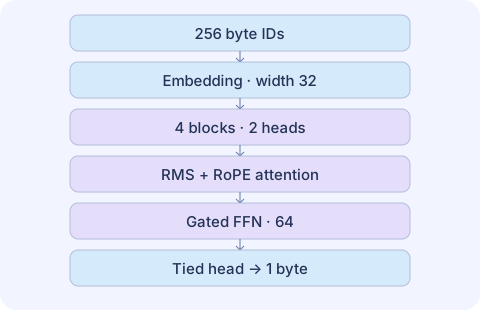
49,568 parameters · STE binary projections
Width 32 · 4 layers · 2 heads
Index — not quality-qualified
Diagram · description · code · screen results →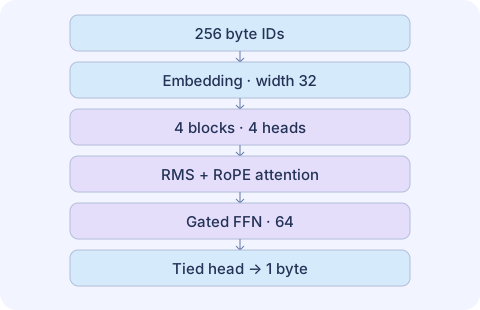
49,568 parameters · STE binary projections
Width 32 · 4 layers · 4 heads
Index — not quality-qualified
Diagram · description · code · 3-seed curves →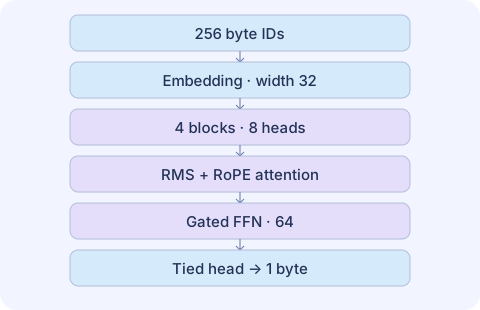
49,568 parameters · STE binary projections
Width 32 · 4 layers · 8 heads
Index — not quality-qualified
Diagram · description · code · screen results →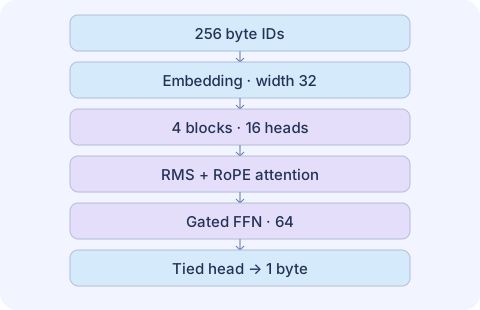
49,568 parameters · STE binary projections
Width 32 · 4 layers · 16 heads
Index — not quality-qualified
Diagram · description · code · screen results →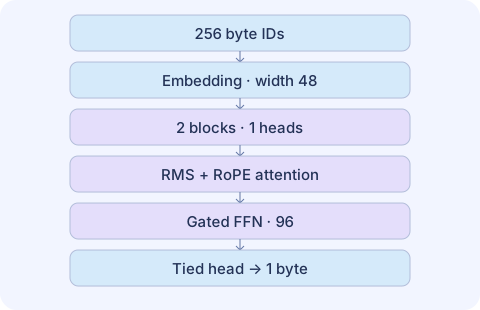
58,704 parameters · STE binary projections
Width 48 · 2 layers · 1 heads
Index — not quality-qualified
Diagram · description · code · screen results →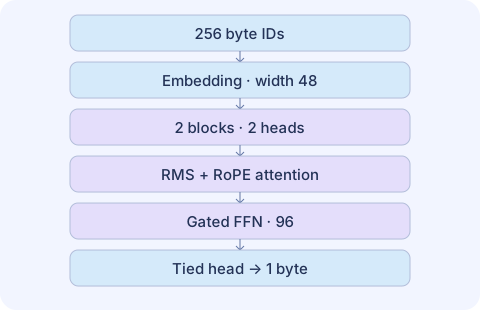
58,704 parameters · STE binary projections
Width 48 · 2 layers · 2 heads
Index — not quality-qualified
Diagram · description · code · screen results →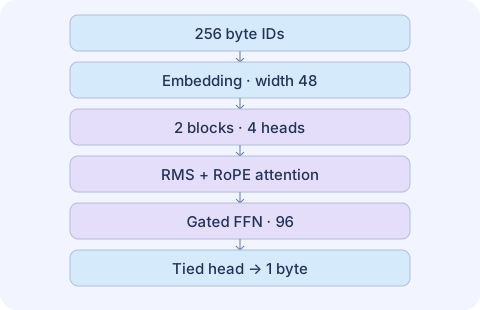
58,704 parameters · STE binary projections
Width 48 · 2 layers · 4 heads
Index — not quality-qualified
Diagram · description · code · screen results →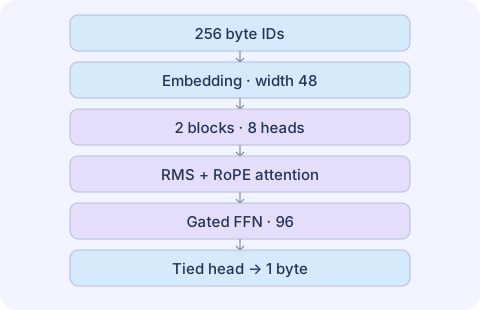
58,704 parameters · STE binary projections
Width 48 · 2 layers · 8 heads
Index — not quality-qualified
Diagram · description · code · screen results →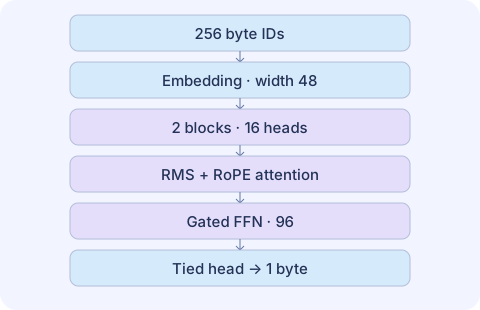
58,704 parameters · STE binary projections
Width 48 · 2 layers · 16 heads
Index — not quality-qualified
Diagram · description · code · screen results →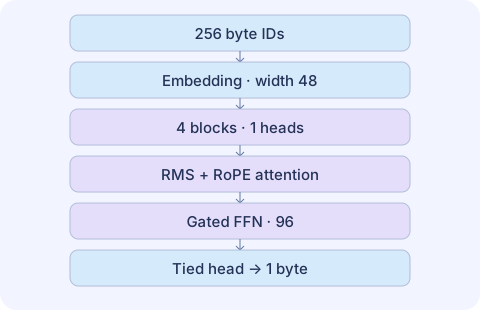
105,072 parameters · STE binary projections
Width 48 · 4 layers · 1 heads
Index — not quality-qualified
Diagram · description · code · screen results →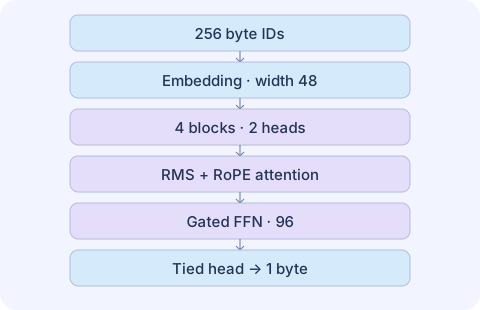
105,072 parameters · STE binary projections
Width 48 · 4 layers · 2 heads
Index — not quality-qualified
Diagram · description · code · screen results →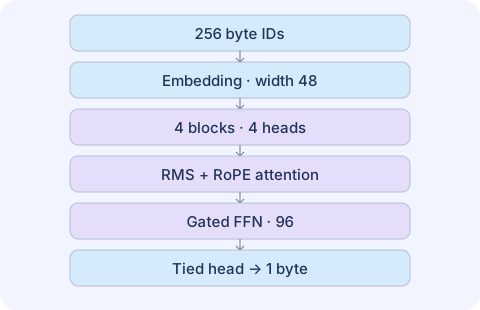
105,072 parameters · STE binary projections
Width 48 · 4 layers · 4 heads
Index — not quality-qualified
Diagram · description · code · screen results →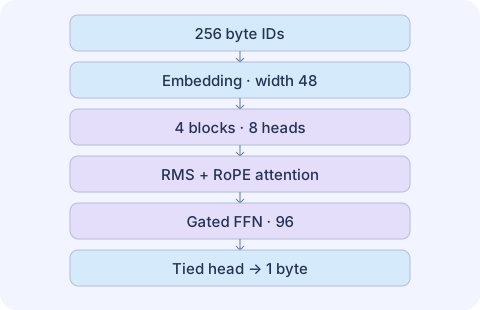
105,072 parameters · STE binary projections
Width 48 · 4 layers · 8 heads
Index — not quality-qualified
Diagram · description · code · screen results →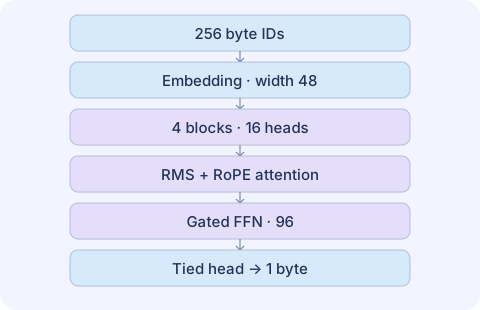
105,072 parameters · STE binary projections
Width 48 · 4 layers · 16 heads
Index — not quality-qualified
Diagram · description · code · screen results →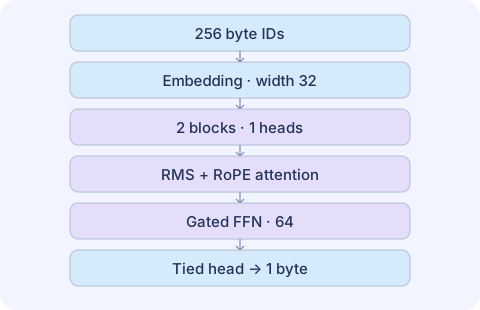
28,896 parameters · Floating-point projections
Width 32 · 2 layers · 1 heads
Index — not quality-qualified
Diagram · description · code · screen results →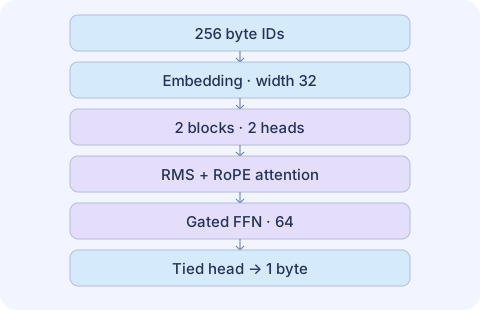
28,896 parameters · Floating-point projections
Width 32 · 2 layers · 2 heads
Index — not quality-qualified
Diagram · description · code · screen results →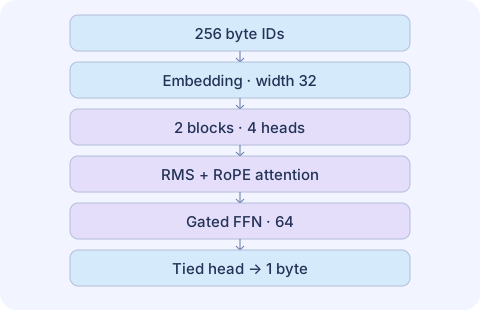
28,896 parameters · Floating-point projections
Width 32 · 2 layers · 4 heads
Index — not quality-qualified
Diagram · description · code · screen results →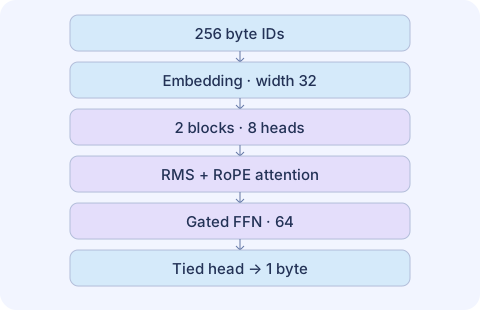
28,896 parameters · Floating-point projections
Width 32 · 2 layers · 8 heads
Index — not quality-qualified
Diagram · description · code · screen results →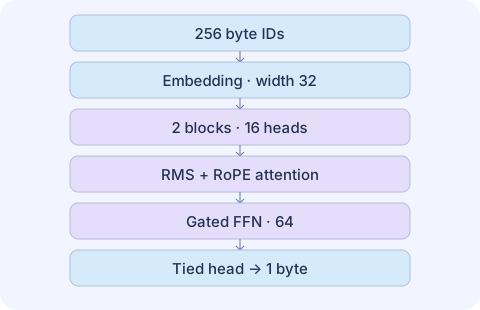
28,896 parameters · Floating-point projections
Width 32 · 2 layers · 16 heads
Index — not quality-qualified
Diagram · description · code · screen results →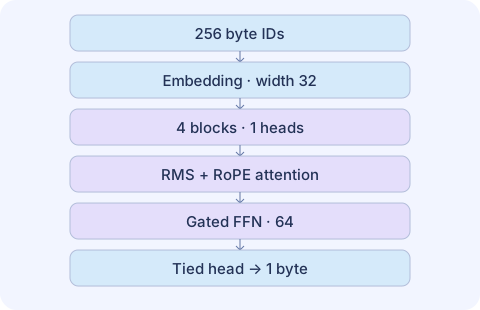
49,568 parameters · Floating-point projections
Width 32 · 4 layers · 1 heads
Index — not quality-qualified
Diagram · description · code · screen results →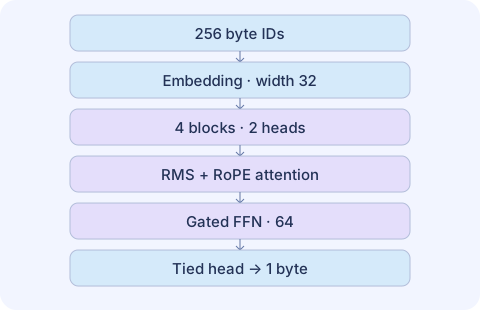
49,568 parameters · Floating-point projections
Width 32 · 4 layers · 2 heads
Index — not quality-qualified
Diagram · description · code · screen results →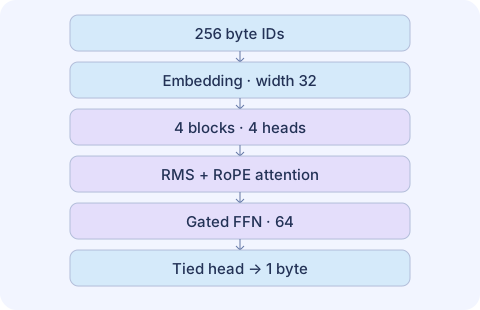
49,568 parameters · Floating-point projections
Width 32 · 4 layers · 4 heads
Index — not quality-qualified
Diagram · description · code · 3-seed curves →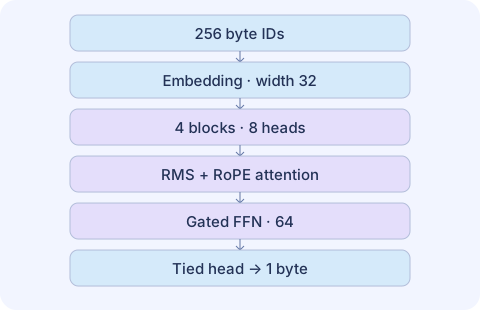
49,568 parameters · Floating-point projections
Width 32 · 4 layers · 8 heads
Index — not quality-qualified
Diagram · description · code · screen results →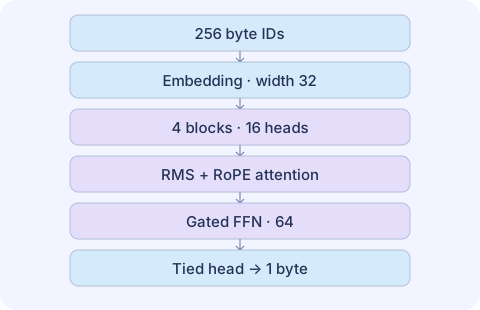
49,568 parameters · Floating-point projections
Width 32 · 4 layers · 16 heads
Index — not quality-qualified
Diagram · description · code · screen results →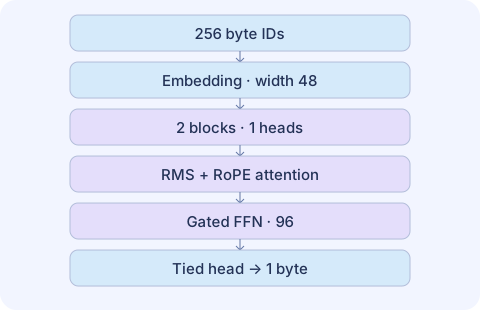
58,704 parameters · Floating-point projections
Width 48 · 2 layers · 1 heads
Index — not quality-qualified
Diagram · description · code · screen results →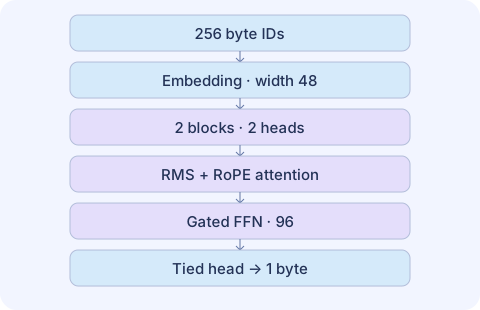
58,704 parameters · Floating-point projections
Width 48 · 2 layers · 2 heads
Index — not quality-qualified
Diagram · description · code · screen results →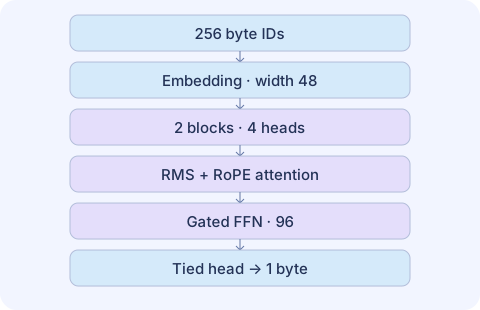
58,704 parameters · Floating-point projections
Width 48 · 2 layers · 4 heads
Index — not quality-qualified
Diagram · description · code · screen results →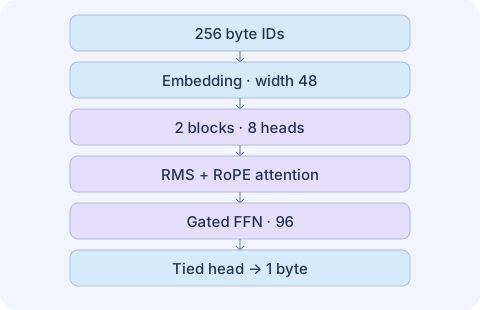
58,704 parameters · Floating-point projections
Width 48 · 2 layers · 8 heads
Index — not quality-qualified
Diagram · description · code · screen results →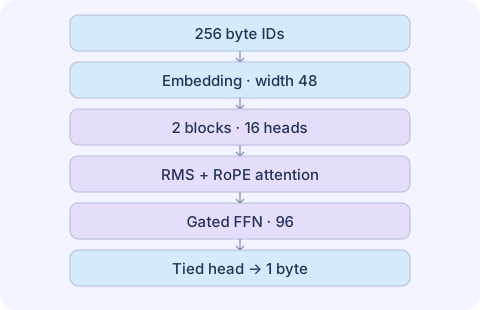
58,704 parameters · Floating-point projections
Width 48 · 2 layers · 16 heads
Index — not quality-qualified
Diagram · description · code · screen results →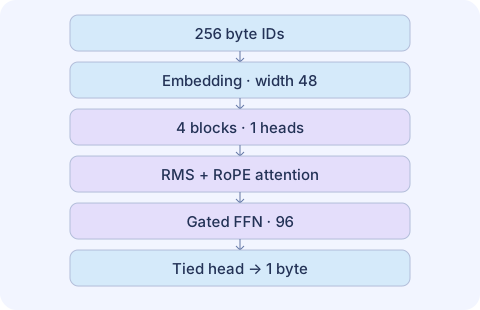
105,072 parameters · Floating-point projections
Width 48 · 4 layers · 1 heads
Index — not quality-qualified
Diagram · description · code · screen results →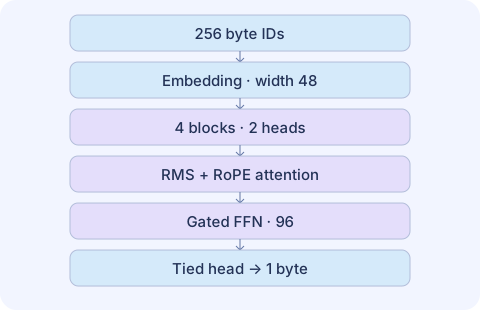
105,072 parameters · Floating-point projections
Width 48 · 4 layers · 2 heads
Index — not quality-qualified
Diagram · description · code · screen results →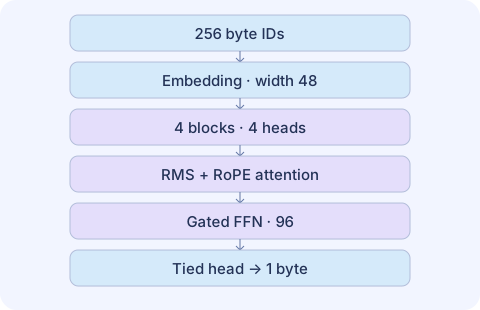
105,072 parameters · Floating-point projections
Width 48 · 4 layers · 4 heads
Index — not quality-qualified
Diagram · description · code · screen results →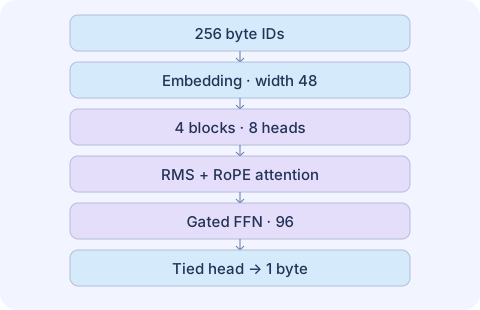
105,072 parameters · Floating-point projections
Width 48 · 4 layers · 8 heads
Index — not quality-qualified
Diagram · description · code · screen results →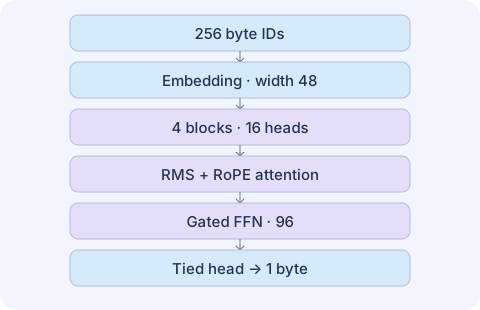
105,072 parameters · Floating-point projections
Width 48 · 4 layers · 16 heads
Index — not quality-qualified
Diagram · description · code · screen results →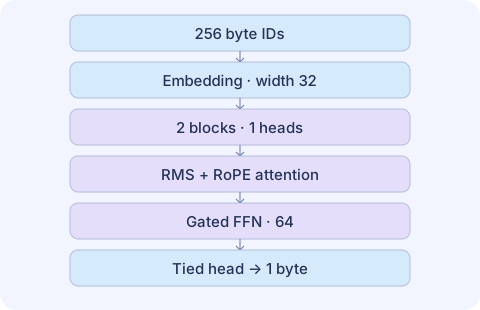
28,896 parameters · STE binary projections
Width 32 · 2 layers · 1 heads
Index — not quality-qualified
Diagram · description · code · screen results →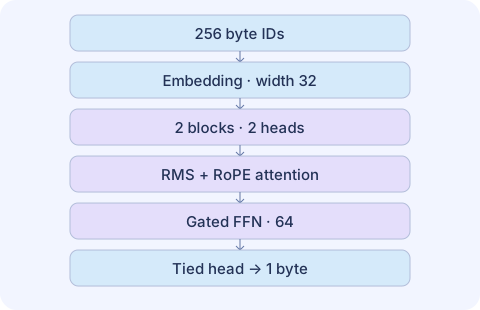
28,896 parameters · STE binary projections
Width 32 · 2 layers · 2 heads
Index — not quality-qualified
Diagram · description · code · screen results →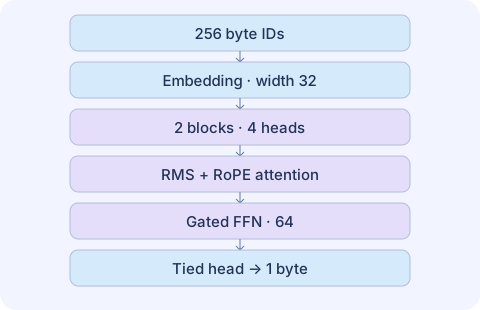
28,896 parameters · STE binary projections
Width 32 · 2 layers · 4 heads
Index — not quality-qualified
Diagram · description · code · screen results →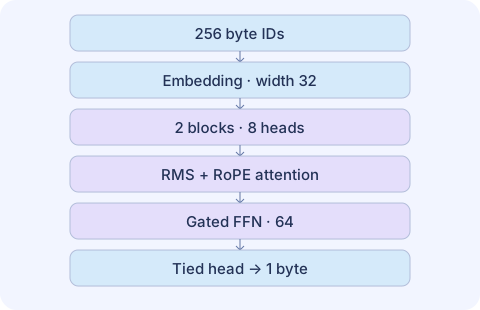
28,896 parameters · STE binary projections
Width 32 · 2 layers · 8 heads
Index — not quality-qualified
Diagram · description · code · screen results →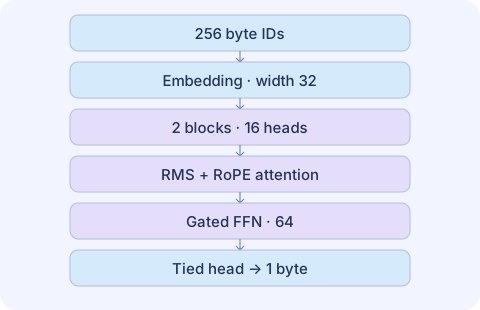
28,896 parameters · STE binary projections
Width 32 · 2 layers · 16 heads
Index — not quality-qualified
Diagram · description · code · screen results →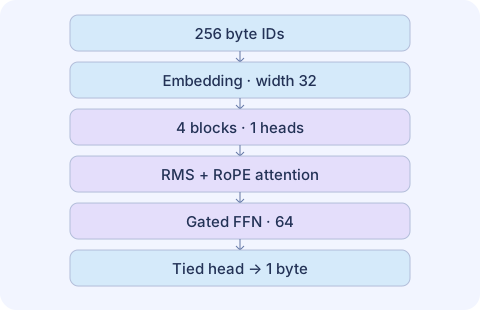
49,568 parameters · STE binary projections
Width 32 · 4 layers · 1 heads
Index — not quality-qualified
Diagram · description · code · screen results →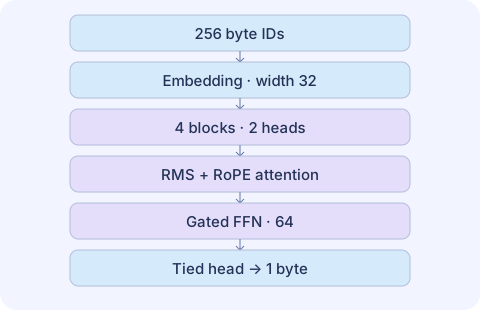
49,568 parameters · STE binary projections
Width 32 · 4 layers · 2 heads
Index — not quality-qualified
Diagram · description · code · screen results →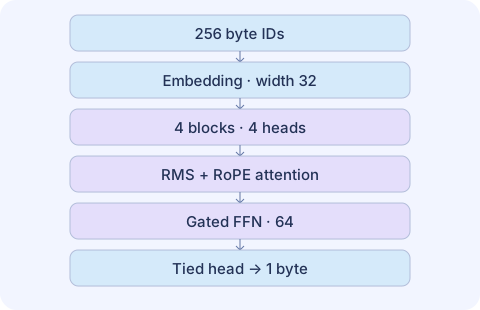
49,568 parameters · STE binary projections
Width 32 · 4 layers · 4 heads
Index — not quality-qualified
Diagram · description · code · 3-seed curves →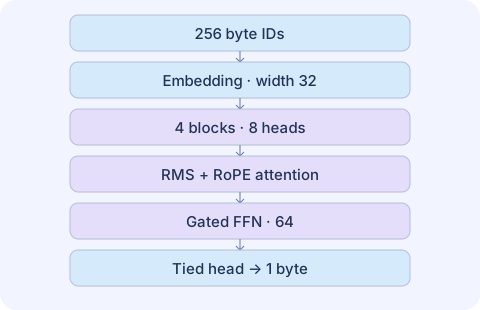
49,568 parameters · STE binary projections
Width 32 · 4 layers · 8 heads
Index — not quality-qualified
Diagram · description · code · screen results →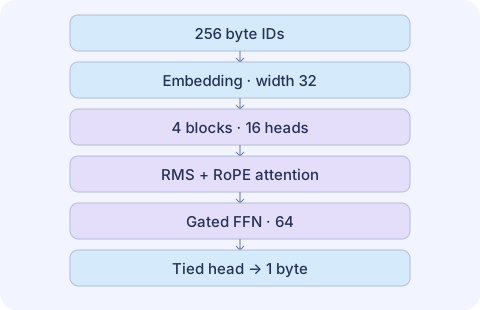
49,568 parameters · STE binary projections
Width 32 · 4 layers · 16 heads
Index — not quality-qualified
Diagram · description · code · screen results →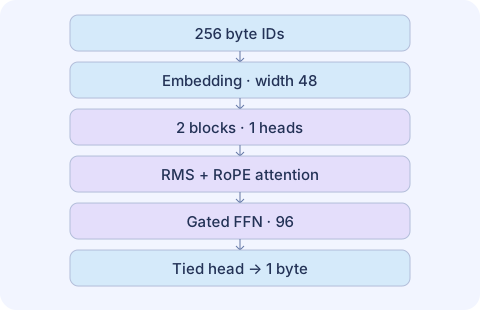
58,704 parameters · STE binary projections
Width 48 · 2 layers · 1 heads
Index — not quality-qualified
Diagram · description · code · screen results →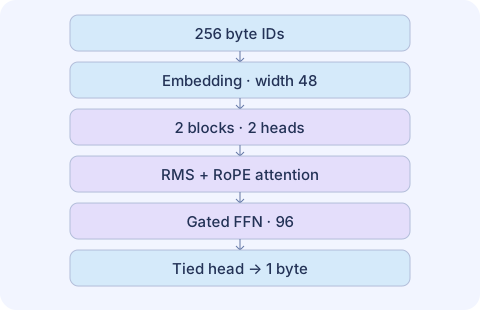
58,704 parameters · STE binary projections
Width 48 · 2 layers · 2 heads
Index — not quality-qualified
Diagram · description · code · screen results →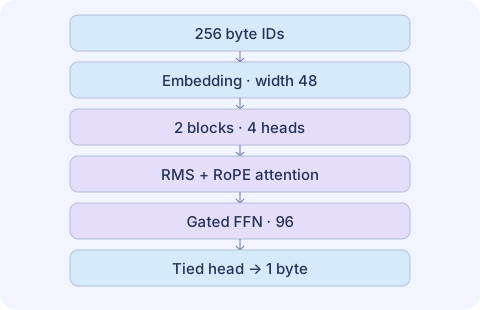
58,704 parameters · STE binary projections
Width 48 · 2 layers · 4 heads
Index — not quality-qualified
Diagram · description · code · screen results →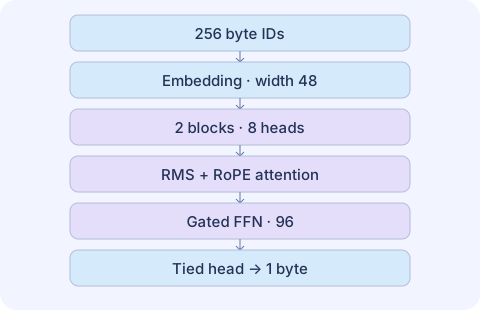
58,704 parameters · STE binary projections
Width 48 · 2 layers · 8 heads
Index — not quality-qualified
Diagram · description · code · screen results →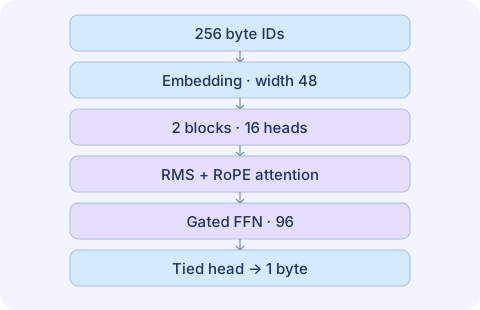
58,704 parameters · STE binary projections
Width 48 · 2 layers · 16 heads
Index — not quality-qualified
Diagram · description · code · screen results →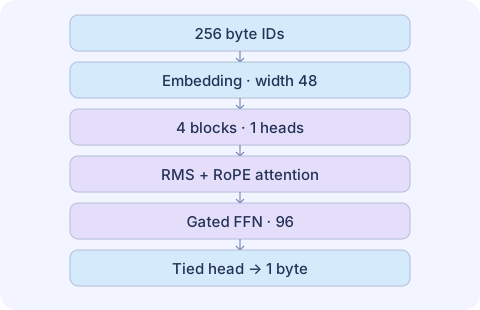
105,072 parameters · STE binary projections
Width 48 · 4 layers · 1 heads
Index — not quality-qualified
Diagram · description · code · screen results →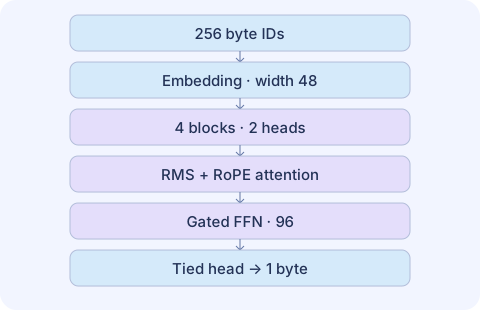
105,072 parameters · STE binary projections
Width 48 · 4 layers · 2 heads
Index — not quality-qualified
Diagram · description · code · screen results →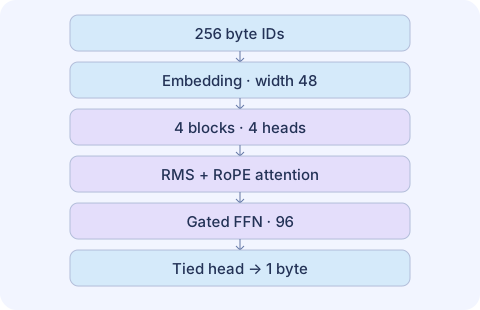
105,072 parameters · STE binary projections
Width 48 · 4 layers · 4 heads
Index — not quality-qualified
Diagram · description · code · screen results →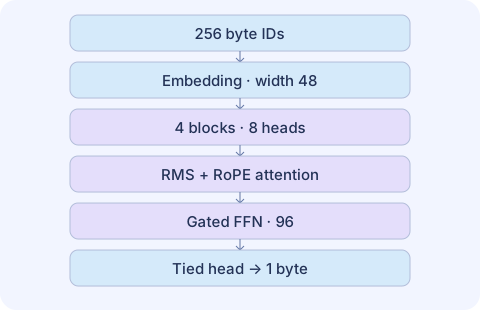
105,072 parameters · STE binary projections
Width 48 · 4 layers · 8 heads
Index — not quality-qualified
Diagram · description · code · screen results →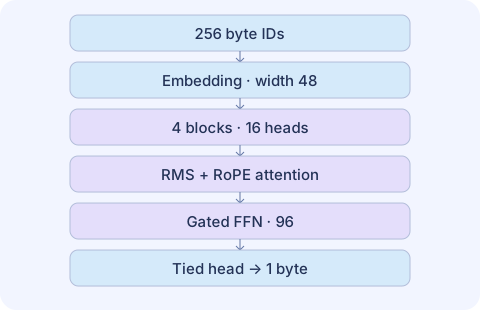
105,072 parameters · STE binary projections
Width 48 · 4 layers · 16 heads
Index — not quality-qualified
Diagram · description · code · screen results →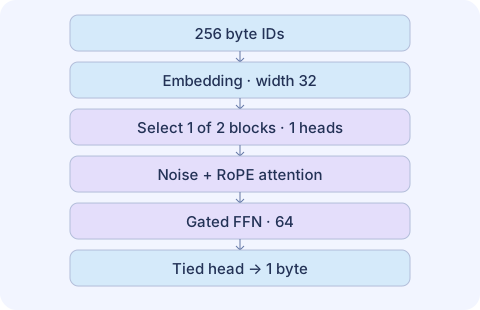
28,896 parameters · Floating-point projections
Width 32 · 2 layers · 1 heads
Index — not quality-qualified
Diagram · description · code · screen results →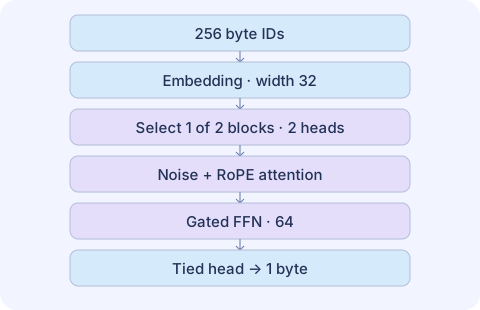
28,896 parameters · Floating-point projections
Width 32 · 2 layers · 2 heads
Index — not quality-qualified
Diagram · description · code · screen results →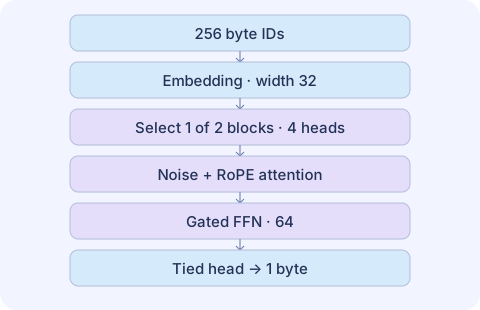
28,896 parameters · Floating-point projections
Width 32 · 2 layers · 4 heads
Index — not quality-qualified
Diagram · description · code · screen results →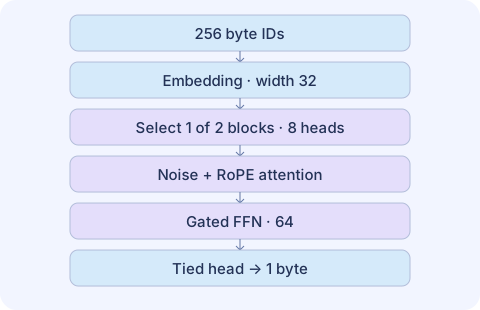
28,896 parameters · Floating-point projections
Width 32 · 2 layers · 8 heads
Index — not quality-qualified
Diagram · description · code · screen results →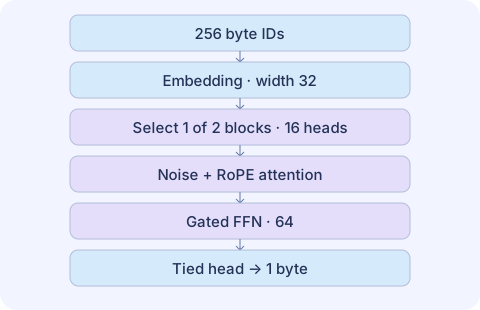
28,896 parameters · Floating-point projections
Width 32 · 2 layers · 16 heads
Index — not quality-qualified
Diagram · description · code · screen results →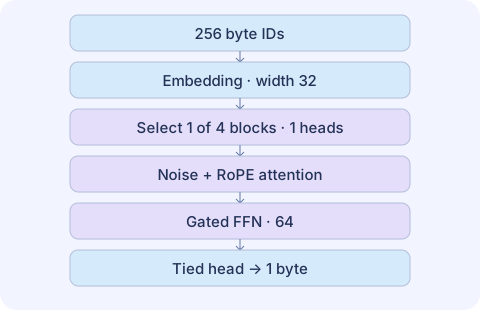
49,568 parameters · Floating-point projections
Width 32 · 4 layers · 1 heads
Index — not quality-qualified
Diagram · description · code · screen results →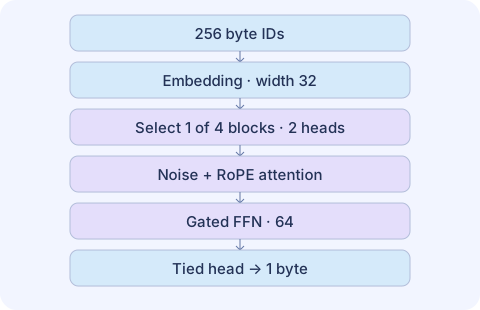
49,568 parameters · Floating-point projections
Width 32 · 4 layers · 2 heads
Index — not quality-qualified
Diagram · description · code · screen results →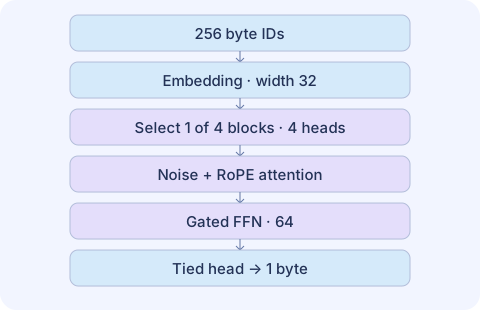
49,568 parameters · Floating-point projections
Width 32 · 4 layers · 4 heads
Index — not quality-qualified
Diagram · description · code · 3-seed curves →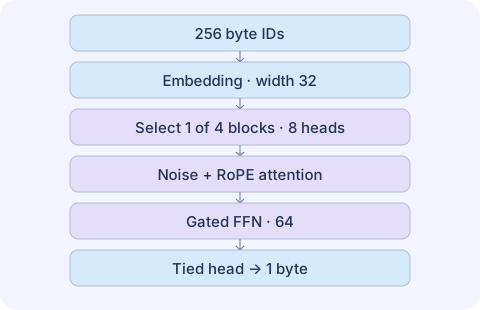
49,568 parameters · Floating-point projections
Width 32 · 4 layers · 8 heads
Index — not quality-qualified
Diagram · description · code · screen results →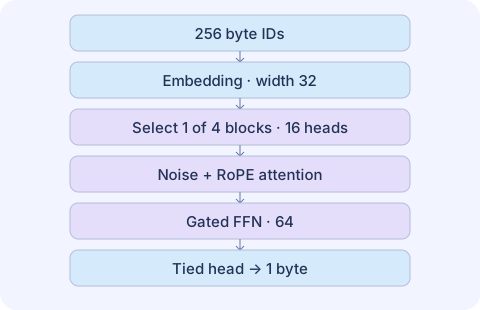
49,568 parameters · Floating-point projections
Width 32 · 4 layers · 16 heads
Index — not quality-qualified
Diagram · description · code · screen results →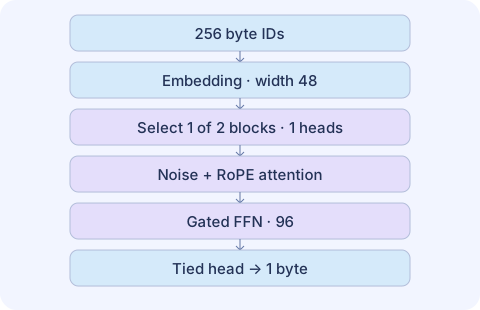
58,704 parameters · Floating-point projections
Width 48 · 2 layers · 1 heads
Index — not quality-qualified
Diagram · description · code · screen results →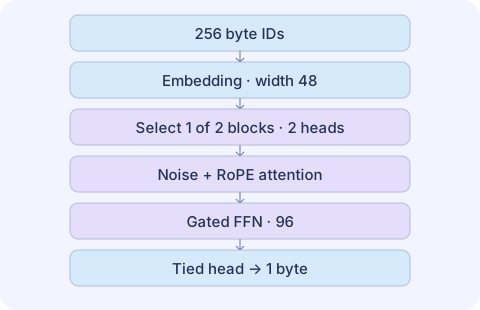
58,704 parameters · Floating-point projections
Width 48 · 2 layers · 2 heads
Index — not quality-qualified
Diagram · description · code · screen results →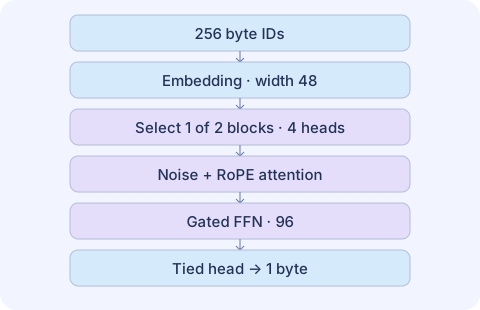
58,704 parameters · Floating-point projections
Width 48 · 2 layers · 4 heads
Index — not quality-qualified
Diagram · description · code · screen results →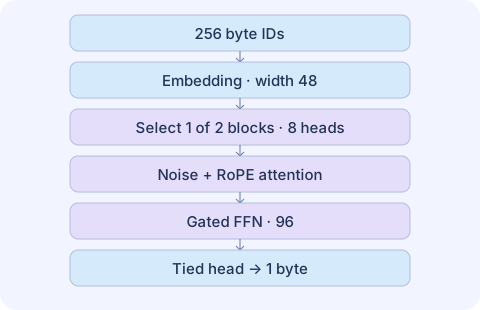
58,704 parameters · Floating-point projections
Width 48 · 2 layers · 8 heads
Index — not quality-qualified
Diagram · description · code · screen results →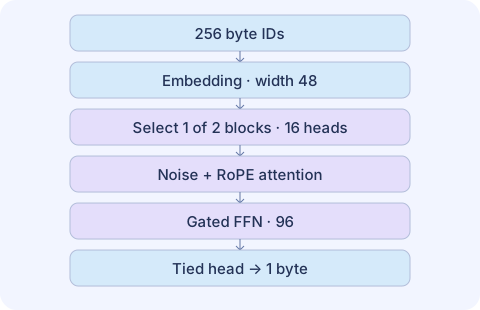
58,704 parameters · Floating-point projections
Width 48 · 2 layers · 16 heads
Index — not quality-qualified
Diagram · description · code · screen results →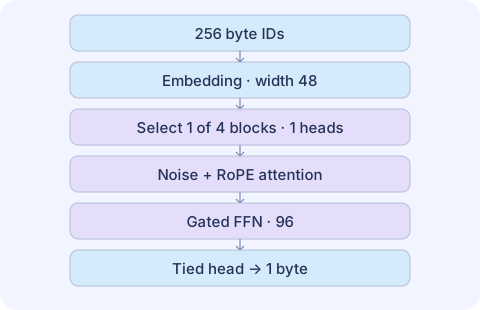
105,072 parameters · Floating-point projections
Width 48 · 4 layers · 1 heads
Index — not quality-qualified
Diagram · description · code · screen results →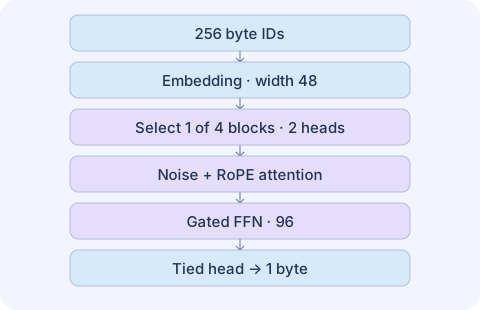
105,072 parameters · Floating-point projections
Width 48 · 4 layers · 2 heads
Index — not quality-qualified
Diagram · description · code · screen results →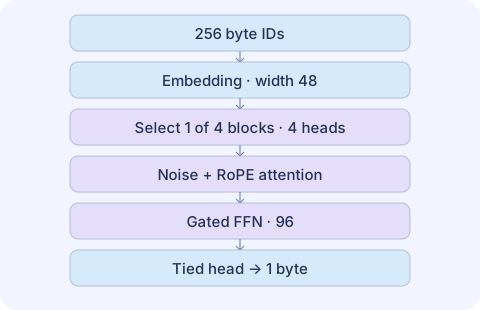
105,072 parameters · Floating-point projections
Width 48 · 4 layers · 4 heads
Index — not quality-qualified
Diagram · description · code · screen results →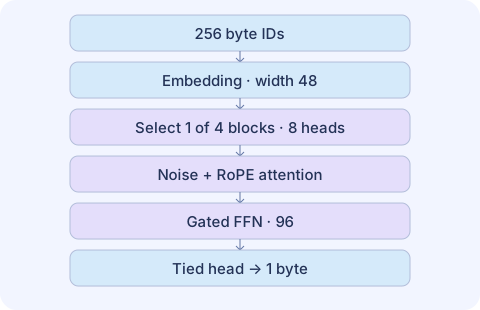
105,072 parameters · Floating-point projections
Width 48 · 4 layers · 8 heads
Index — not quality-qualified
Diagram · description · code · screen results →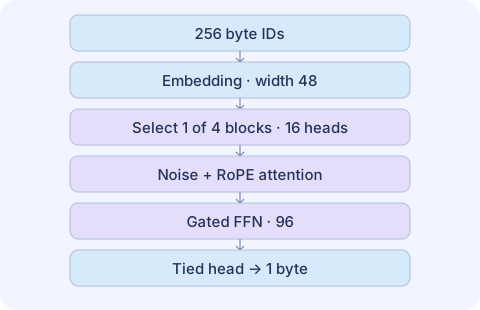
105,072 parameters · Floating-point projections
Width 48 · 4 layers · 16 heads
Index — not quality-qualified
Diagram · description · code · screen results →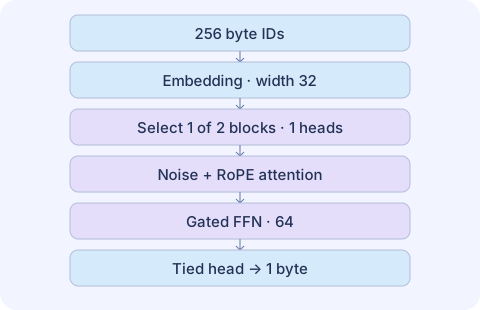
28,896 parameters · STE binary projections
Width 32 · 2 layers · 1 heads
Index — not quality-qualified
Diagram · description · code · screen results →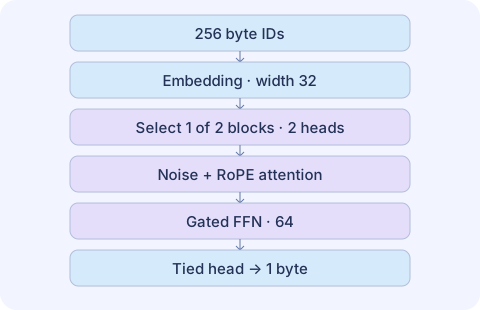
28,896 parameters · STE binary projections
Width 32 · 2 layers · 2 heads
Index — not quality-qualified
Diagram · description · code · screen results →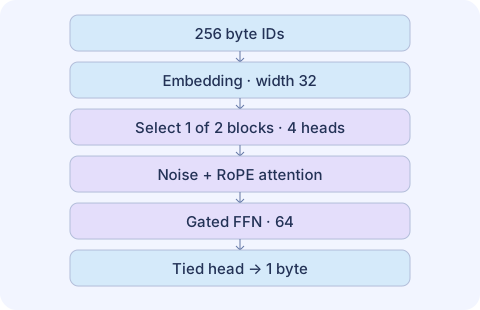
28,896 parameters · STE binary projections
Width 32 · 2 layers · 4 heads
Index — not quality-qualified
Diagram · description · code · screen results →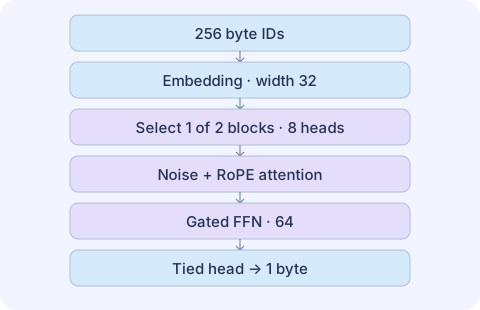
28,896 parameters · STE binary projections
Width 32 · 2 layers · 8 heads
Index — not quality-qualified
Diagram · description · code · screen results →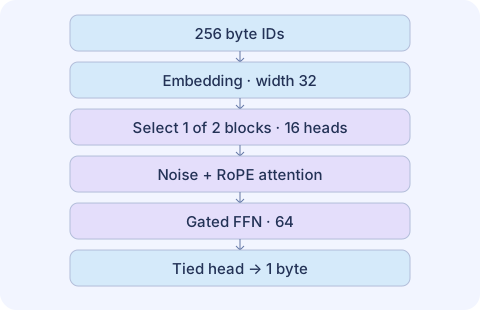
28,896 parameters · STE binary projections
Width 32 · 2 layers · 16 heads
Index — not quality-qualified
Diagram · description · code · screen results →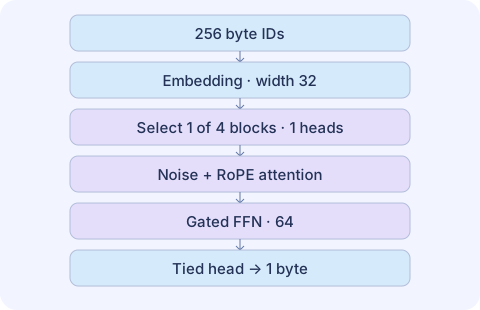
49,568 parameters · STE binary projections
Width 32 · 4 layers · 1 heads
Index — not quality-qualified
Diagram · description · code · screen results →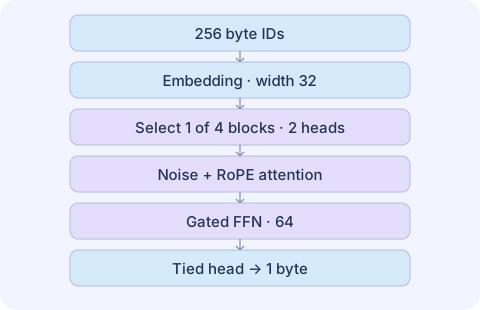
49,568 parameters · STE binary projections
Width 32 · 4 layers · 2 heads
Index — not quality-qualified
Diagram · description · code · screen results →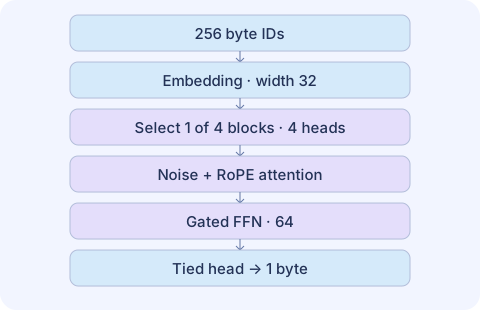
49,568 parameters · STE binary projections
Width 32 · 4 layers · 4 heads
Index — not quality-qualified
Diagram · description · code · 3-seed curves →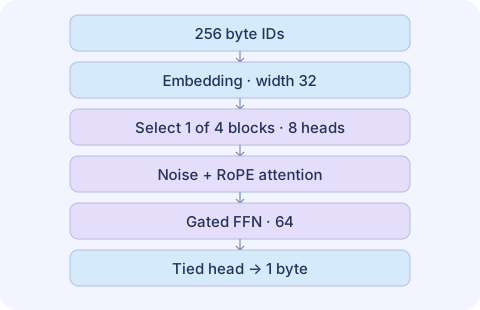
49,568 parameters · STE binary projections
Width 32 · 4 layers · 8 heads
Index — not quality-qualified
Diagram · description · code · screen results →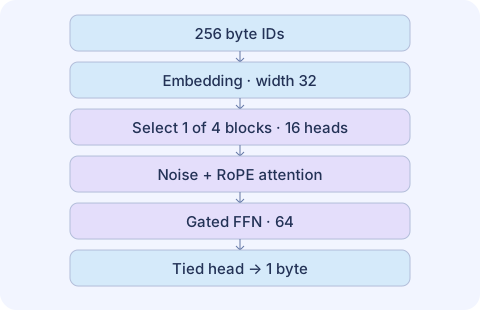
49,568 parameters · STE binary projections
Width 32 · 4 layers · 16 heads
Index — not quality-qualified
Diagram · description · code · screen results →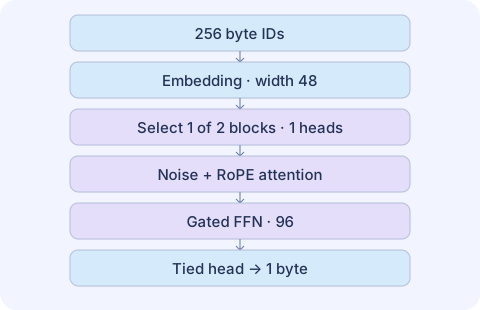
58,704 parameters · STE binary projections
Width 48 · 2 layers · 1 heads
Index — not quality-qualified
Diagram · description · code · screen results →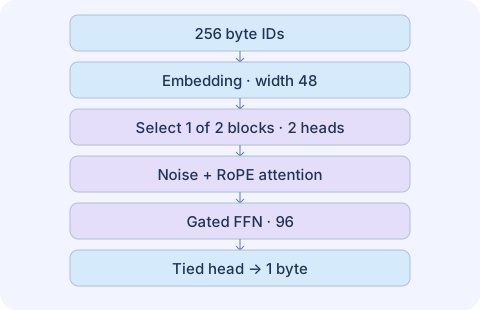
58,704 parameters · STE binary projections
Width 48 · 2 layers · 2 heads
Index — not quality-qualified
Diagram · description · code · screen results →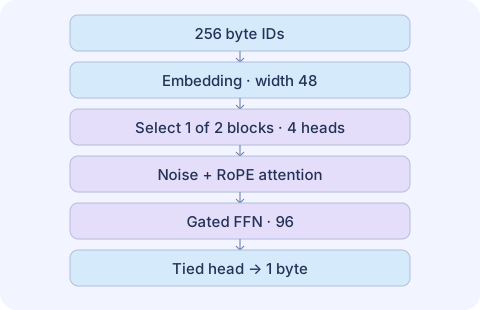
58,704 parameters · STE binary projections
Width 48 · 2 layers · 4 heads
Index — not quality-qualified
Diagram · description · code · screen results →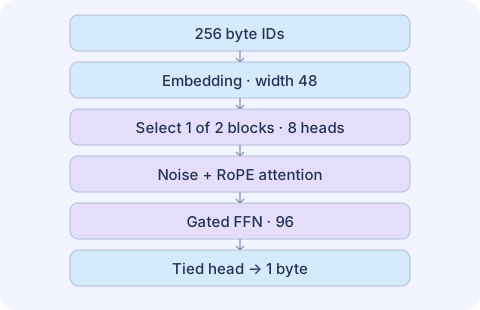
58,704 parameters · STE binary projections
Width 48 · 2 layers · 8 heads
Index — not quality-qualified
Diagram · description · code · screen results →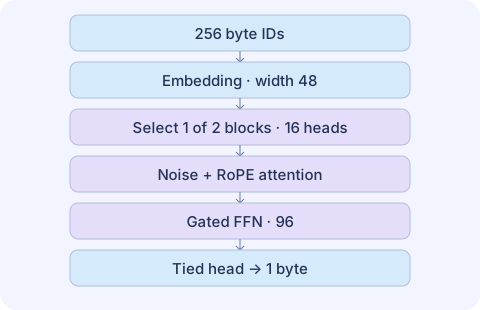
58,704 parameters · STE binary projections
Width 48 · 2 layers · 16 heads
Index — not quality-qualified
Diagram · description · code · screen results →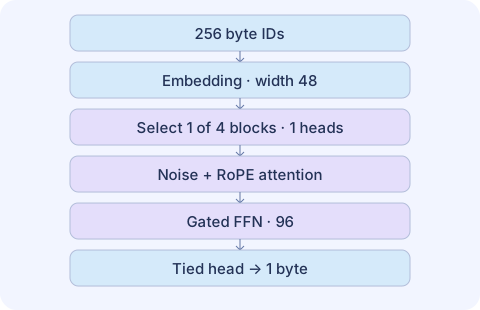
105,072 parameters · STE binary projections
Width 48 · 4 layers · 1 heads
Index — not quality-qualified
Diagram · description · code · screen results →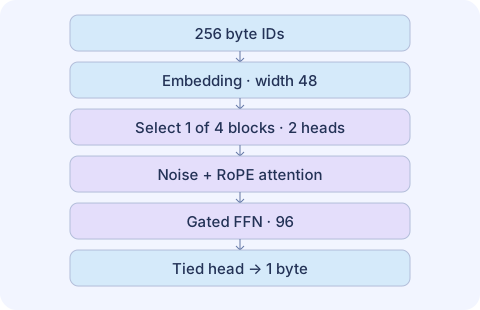
105,072 parameters · STE binary projections
Width 48 · 4 layers · 2 heads
Index — not quality-qualified
Diagram · description · code · screen results →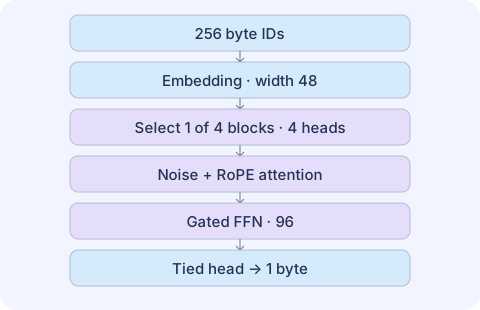
105,072 parameters · STE binary projections
Width 48 · 4 layers · 4 heads
Index — not quality-qualified
Diagram · description · code · screen results →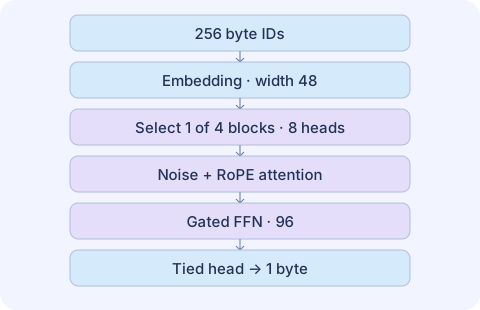
105,072 parameters · STE binary projections
Width 48 · 4 layers · 8 heads
Index — not quality-qualified
Diagram · description · code · screen results →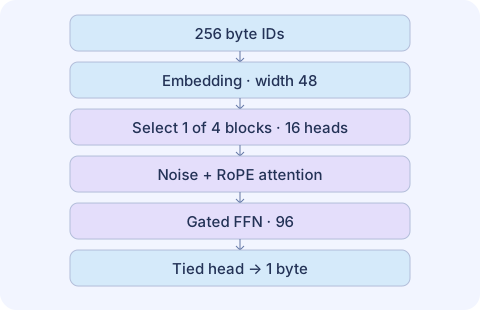
105,072 parameters · STE binary projections
Width 48 · 4 layers · 16 heads
Index — not quality-qualified
Diagram · description · code · screen results →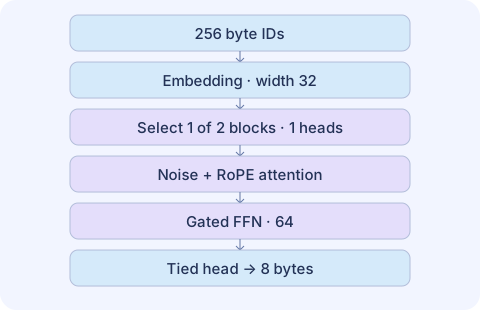
28,896 parameters · Floating-point projections
Width 32 · 2 layers · 1 heads
Index — not quality-qualified
Diagram · description · code · screen results →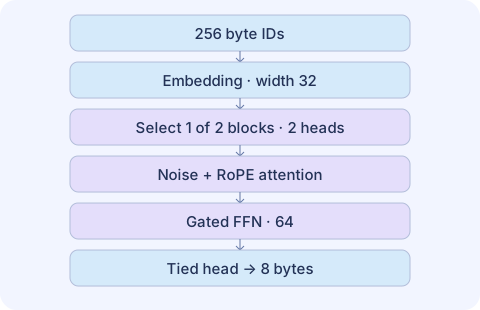
28,896 parameters · Floating-point projections
Width 32 · 2 layers · 2 heads
Index — not quality-qualified
Diagram · description · code · screen results →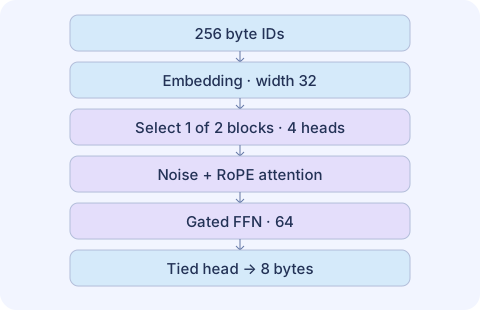
28,896 parameters · Floating-point projections
Width 32 · 2 layers · 4 heads
Index — not quality-qualified
Diagram · description · code · screen results →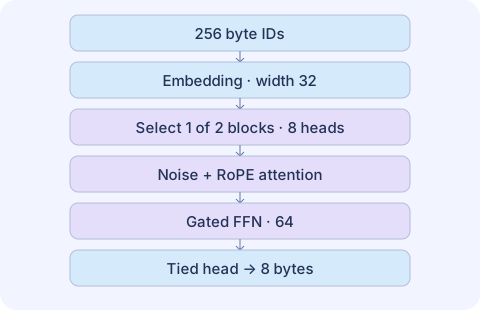
28,896 parameters · Floating-point projections
Width 32 · 2 layers · 8 heads
Index — not quality-qualified
Diagram · description · code · screen results →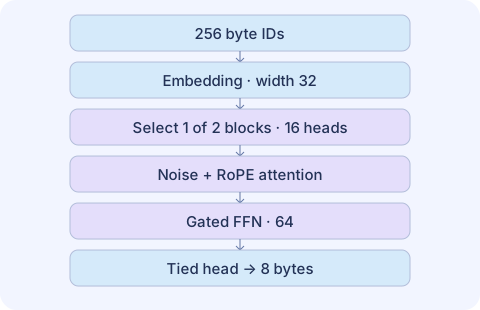
28,896 parameters · Floating-point projections
Width 32 · 2 layers · 16 heads
Index — not quality-qualified
Diagram · description · code · screen results →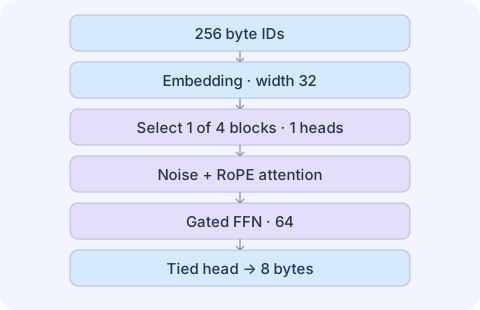
49,568 parameters · Floating-point projections
Width 32 · 4 layers · 1 heads
Index — not quality-qualified
Diagram · description · code · screen results →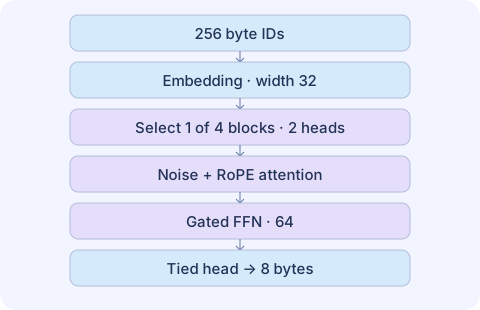
49,568 parameters · Floating-point projections
Width 32 · 4 layers · 2 heads
Index — not quality-qualified
Diagram · description · code · screen results →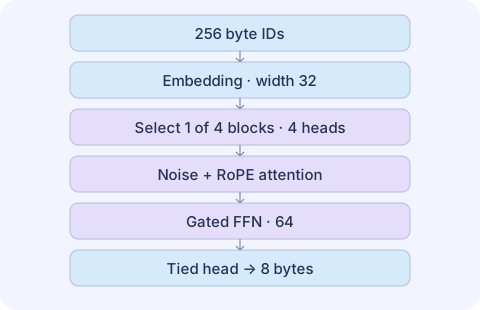
49,568 parameters · Floating-point projections
Width 32 · 4 layers · 4 heads
Index — not quality-qualified
Diagram · description · code · 3-seed curves →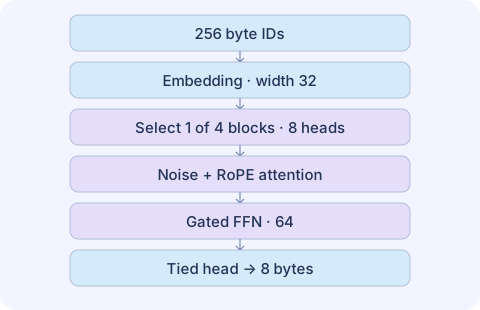
49,568 parameters · Floating-point projections
Width 32 · 4 layers · 8 heads
Index — not quality-qualified
Diagram · description · code · screen results →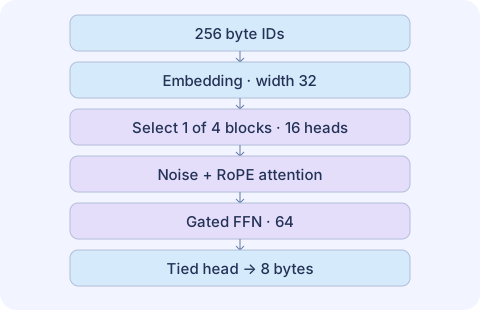
49,568 parameters · Floating-point projections
Width 32 · 4 layers · 16 heads
Index — not quality-qualified
Diagram · description · code · screen results →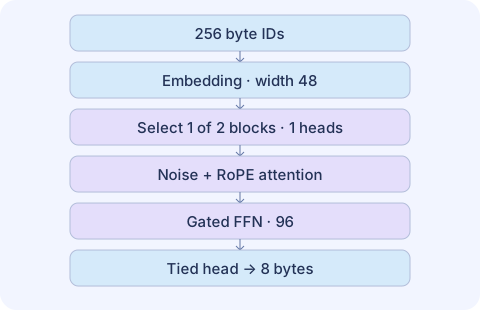
58,704 parameters · Floating-point projections
Width 48 · 2 layers · 1 heads
Index — not quality-qualified
Diagram · description · code · screen results →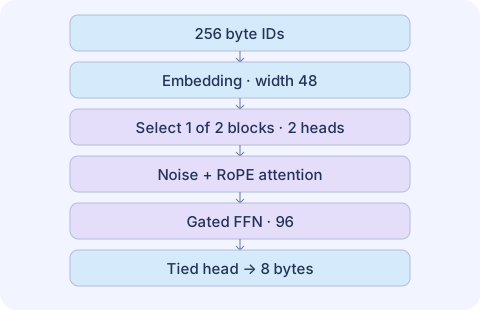
58,704 parameters · Floating-point projections
Width 48 · 2 layers · 2 heads
Index — not quality-qualified
Diagram · description · code · screen results →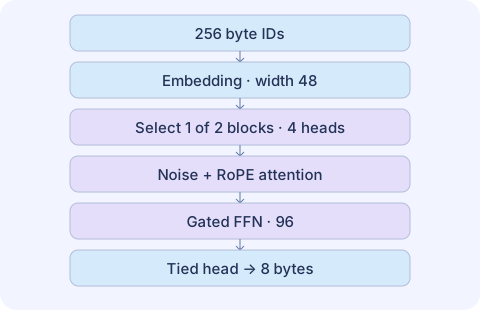
58,704 parameters · Floating-point projections
Width 48 · 2 layers · 4 heads
Index — not quality-qualified
Diagram · description · code · screen results →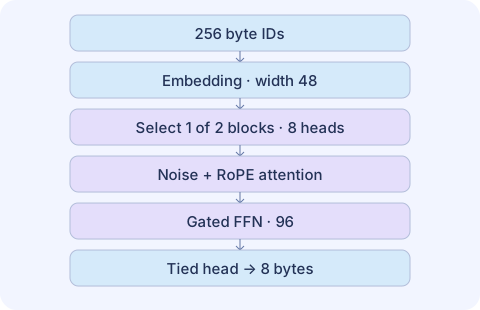
58,704 parameters · Floating-point projections
Width 48 · 2 layers · 8 heads
Index — not quality-qualified
Diagram · description · code · screen results →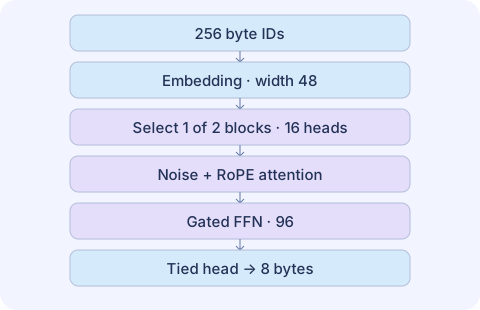
58,704 parameters · Floating-point projections
Width 48 · 2 layers · 16 heads
Index — not quality-qualified
Diagram · description · code · screen results →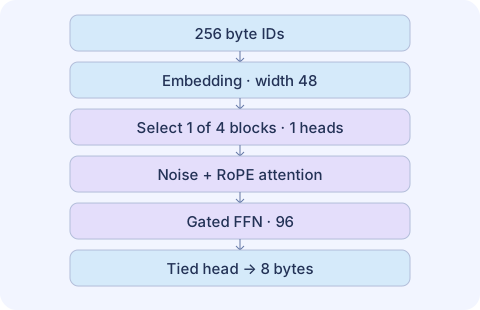
105,072 parameters · Floating-point projections
Width 48 · 4 layers · 1 heads
Index — not quality-qualified
Diagram · description · code · screen results →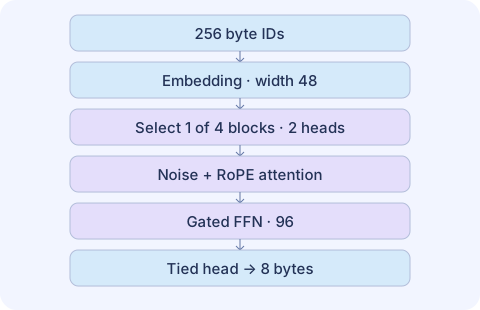
105,072 parameters · Floating-point projections
Width 48 · 4 layers · 2 heads
Index — not quality-qualified
Diagram · description · code · screen results →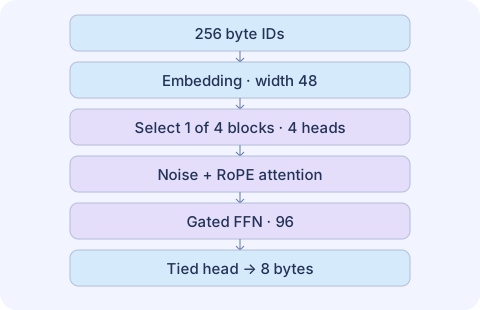
105,072 parameters · Floating-point projections
Width 48 · 4 layers · 4 heads
Index — not quality-qualified
Diagram · description · code · screen results →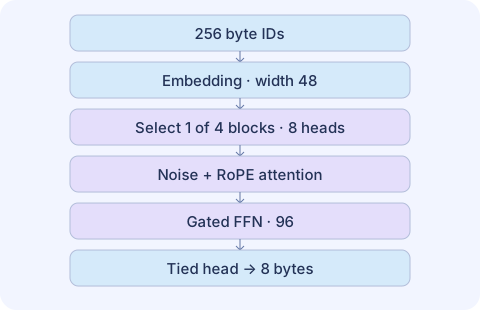
105,072 parameters · Floating-point projections
Width 48 · 4 layers · 8 heads
Index — not quality-qualified
Diagram · description · code · screen results →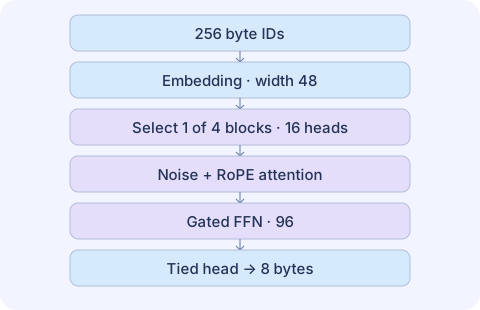
105,072 parameters · Floating-point projections
Width 48 · 4 layers · 16 heads
Index — not quality-qualified
Diagram · description · code · screen results →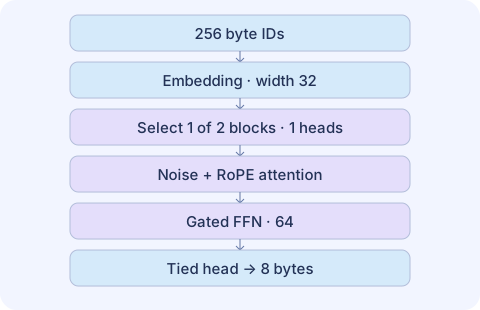
28,896 parameters · STE binary projections
Width 32 · 2 layers · 1 heads
Index — not quality-qualified
Diagram · description · code · screen results →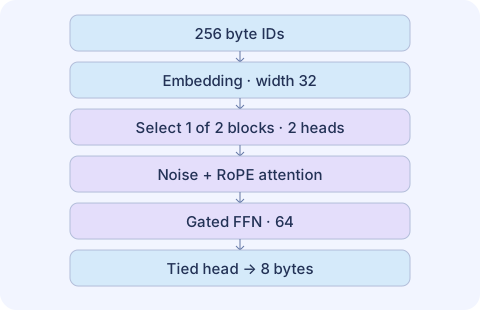
28,896 parameters · STE binary projections
Width 32 · 2 layers · 2 heads
Index — not quality-qualified
Diagram · description · code · screen results →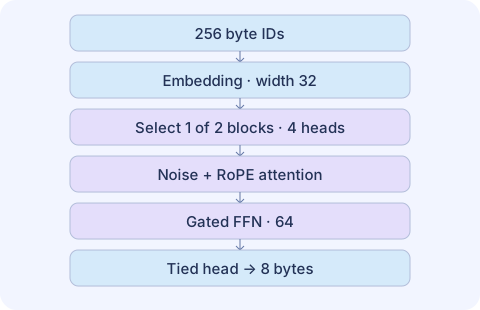
28,896 parameters · STE binary projections
Width 32 · 2 layers · 4 heads
Index — not quality-qualified
Diagram · description · code · screen results →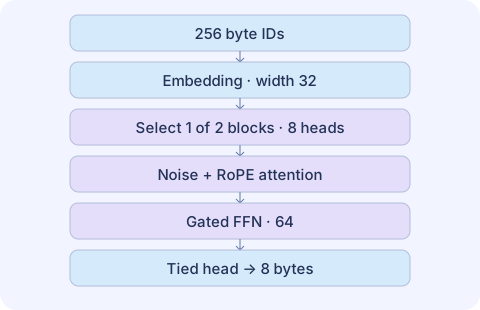
28,896 parameters · STE binary projections
Width 32 · 2 layers · 8 heads
Index — not quality-qualified
Diagram · description · code · screen results →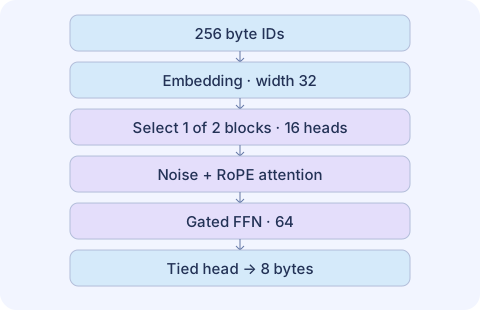
28,896 parameters · STE binary projections
Width 32 · 2 layers · 16 heads
Index — not quality-qualified
Diagram · description · code · screen results →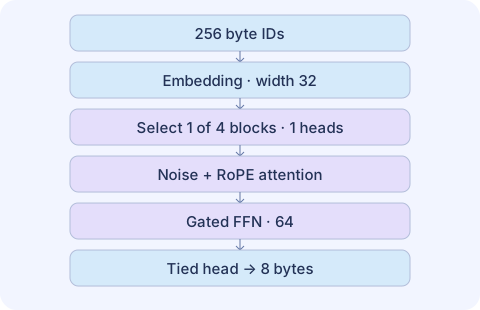
49,568 parameters · STE binary projections
Width 32 · 4 layers · 1 heads
Index — not quality-qualified
Diagram · description · code · screen results →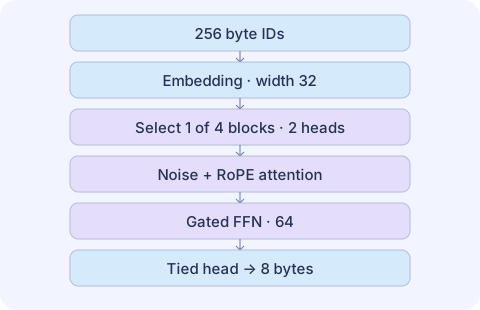
49,568 parameters · STE binary projections
Width 32 · 4 layers · 2 heads
Index — not quality-qualified
Diagram · description · code · screen results →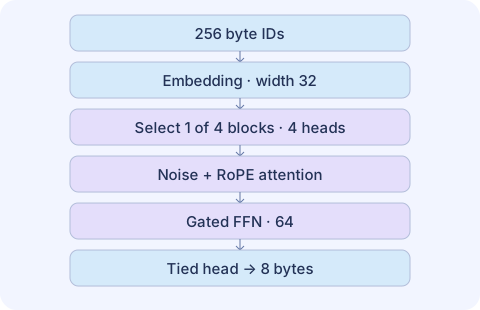
49,568 parameters · STE binary projections
Width 32 · 4 layers · 4 heads
Index — not quality-qualified
Diagram · description · code · 3-seed curves →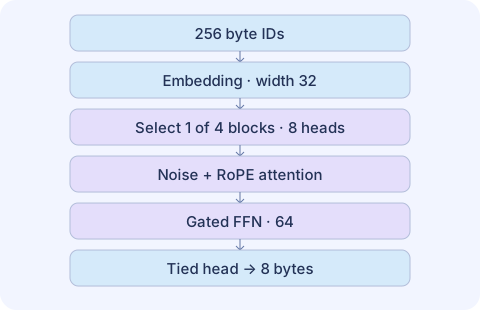
49,568 parameters · STE binary projections
Width 32 · 4 layers · 8 heads
Index — not quality-qualified
Diagram · description · code · screen results →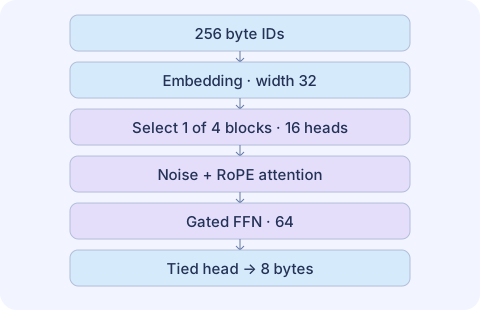
49,568 parameters · STE binary projections
Width 32 · 4 layers · 16 heads
Index — not quality-qualified
Diagram · description · code · screen results →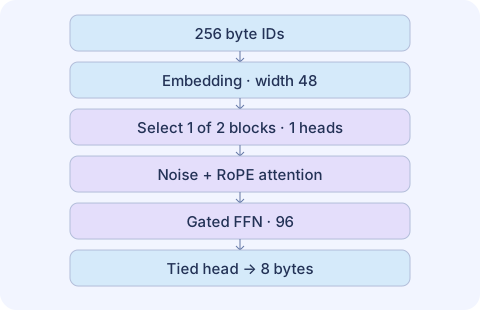
58,704 parameters · STE binary projections
Width 48 · 2 layers · 1 heads
Index — not quality-qualified
Diagram · description · code · screen results →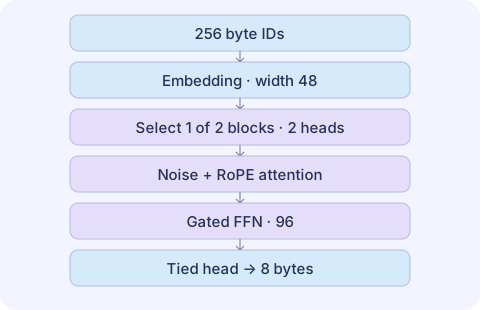
58,704 parameters · STE binary projections
Width 48 · 2 layers · 2 heads
Index — not quality-qualified
Diagram · description · code · screen results →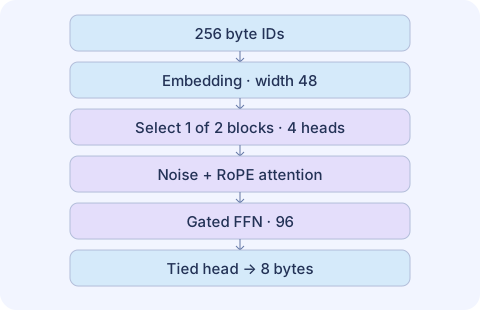
58,704 parameters · STE binary projections
Width 48 · 2 layers · 4 heads
Index — not quality-qualified
Diagram · description · code · screen results →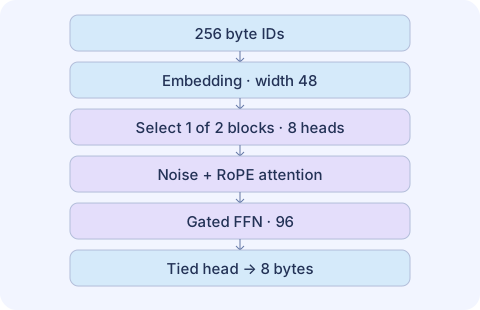
58,704 parameters · STE binary projections
Width 48 · 2 layers · 8 heads
Index — not quality-qualified
Diagram · description · code · screen results →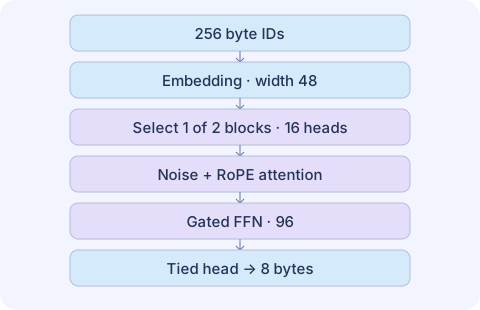
58,704 parameters · STE binary projections
Width 48 · 2 layers · 16 heads
Index — not quality-qualified
Diagram · description · code · screen results →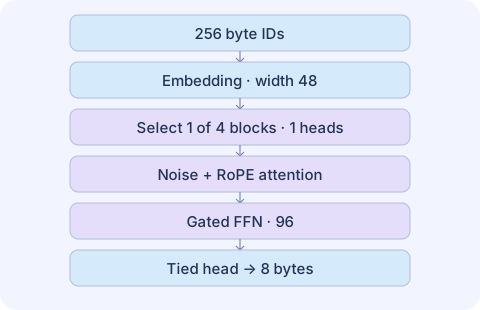
105,072 parameters · STE binary projections
Width 48 · 4 layers · 1 heads
Index — not quality-qualified
Diagram · description · code · screen results →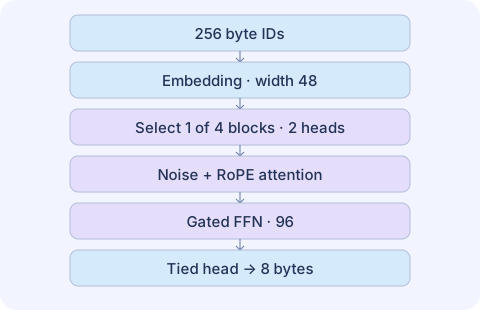
105,072 parameters · STE binary projections
Width 48 · 4 layers · 2 heads
Index — not quality-qualified
Diagram · description · code · screen results →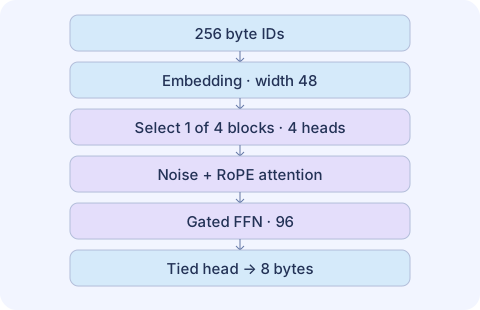
105,072 parameters · STE binary projections
Width 48 · 4 layers · 4 heads
Index — not quality-qualified
Diagram · description · code · screen results →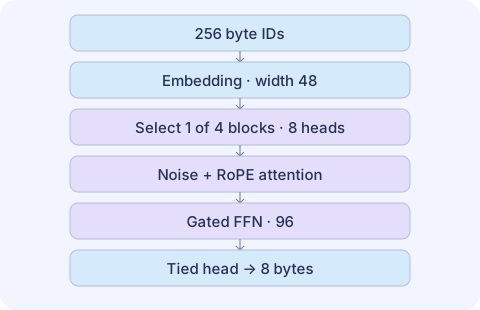
105,072 parameters · STE binary projections
Width 48 · 4 layers · 8 heads
Index — not quality-qualified
Diagram · description · code · screen results →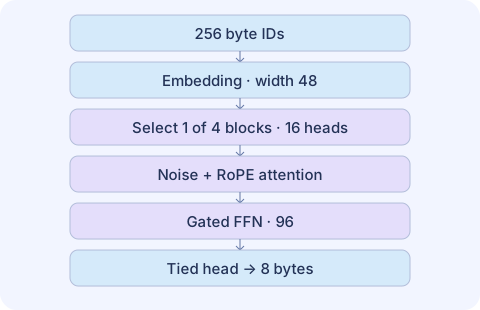
105,072 parameters · STE binary projections
Width 48 · 4 layers · 16 heads
Index — not quality-qualified
Diagram · description · code · screen results →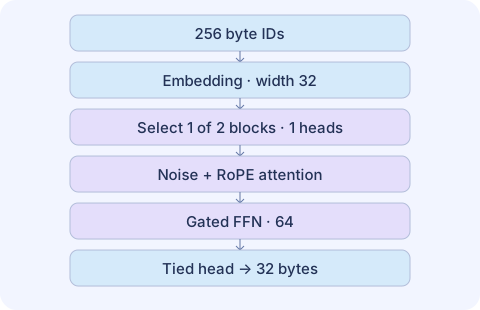
28,896 parameters · Floating-point projections
Width 32 · 2 layers · 1 heads
Index — not quality-qualified
Diagram · description · code · screen results →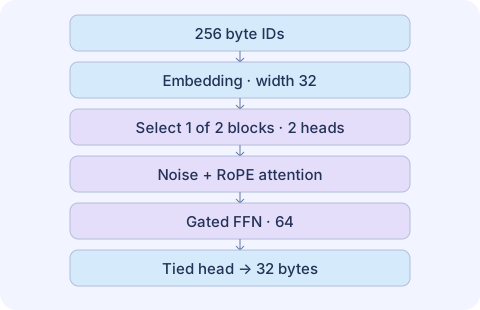
28,896 parameters · Floating-point projections
Width 32 · 2 layers · 2 heads
Index — not quality-qualified
Diagram · description · code · screen results →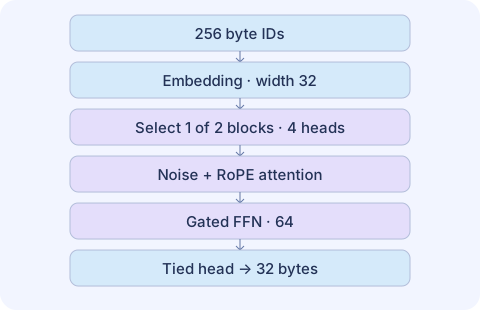
28,896 parameters · Floating-point projections
Width 32 · 2 layers · 4 heads
Index — not quality-qualified
Diagram · description · code · screen results →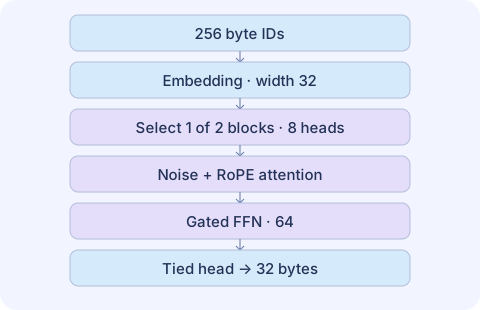
28,896 parameters · Floating-point projections
Width 32 · 2 layers · 8 heads
Index — not quality-qualified
Diagram · description · code · screen results →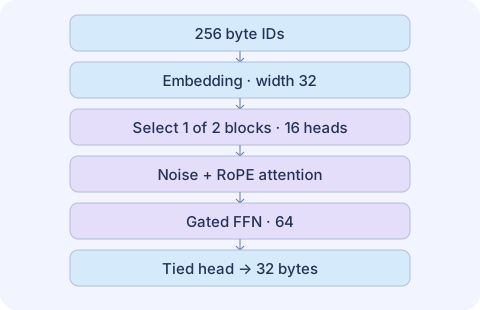
28,896 parameters · Floating-point projections
Width 32 · 2 layers · 16 heads
Index — not quality-qualified
Diagram · description · code · screen results →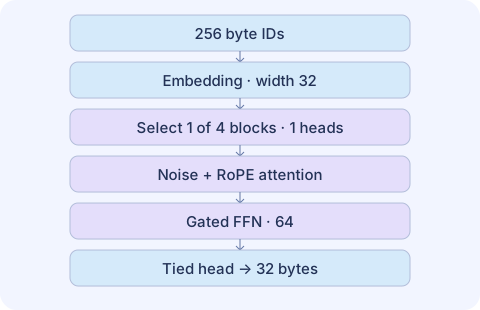
49,568 parameters · Floating-point projections
Width 32 · 4 layers · 1 heads
Index — not quality-qualified
Diagram · description · code · screen results →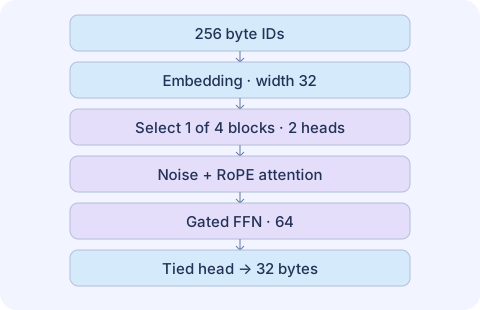
49,568 parameters · Floating-point projections
Width 32 · 4 layers · 2 heads
Index — not quality-qualified
Diagram · description · code · screen results →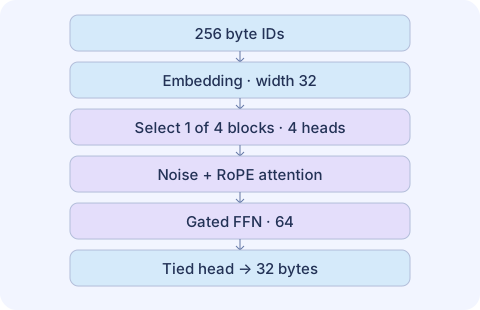
49,568 parameters · Floating-point projections
Width 32 · 4 layers · 4 heads
Index — not quality-qualified
Diagram · description · code · 3-seed curves →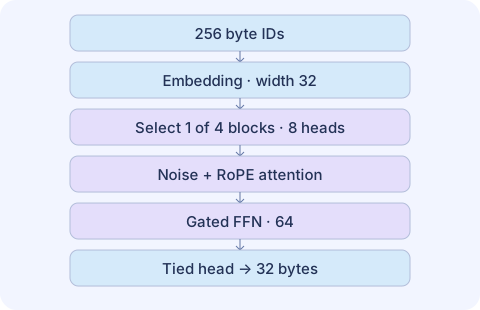
49,568 parameters · Floating-point projections
Width 32 · 4 layers · 8 heads
Index — not quality-qualified
Diagram · description · code · screen results →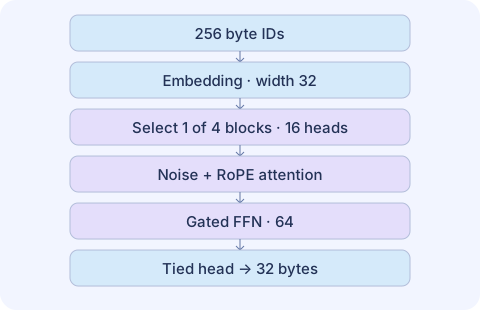
49,568 parameters · Floating-point projections
Width 32 · 4 layers · 16 heads
Index — not quality-qualified
Diagram · description · code · screen results →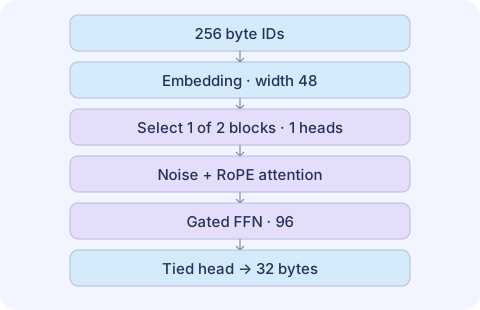
58,704 parameters · Floating-point projections
Width 48 · 2 layers · 1 heads
Index — not quality-qualified
Diagram · description · code · screen results →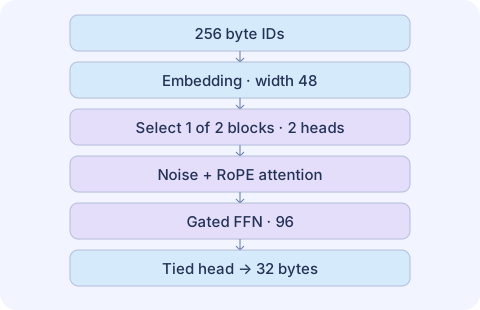
58,704 parameters · Floating-point projections
Width 48 · 2 layers · 2 heads
Index — not quality-qualified
Diagram · description · code · screen results →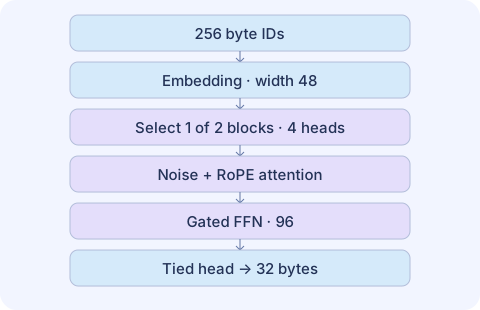
58,704 parameters · Floating-point projections
Width 48 · 2 layers · 4 heads
Index — not quality-qualified
Diagram · description · code · screen results →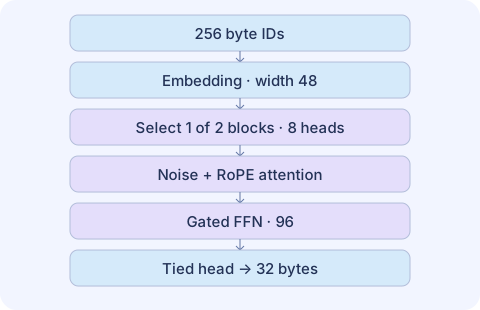
58,704 parameters · Floating-point projections
Width 48 · 2 layers · 8 heads
Index — not quality-qualified
Diagram · description · code · screen results →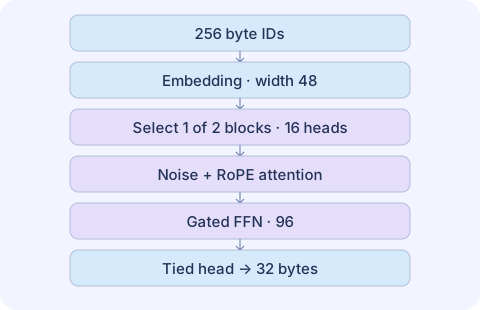
58,704 parameters · Floating-point projections
Width 48 · 2 layers · 16 heads
Index — not quality-qualified
Diagram · description · code · screen results →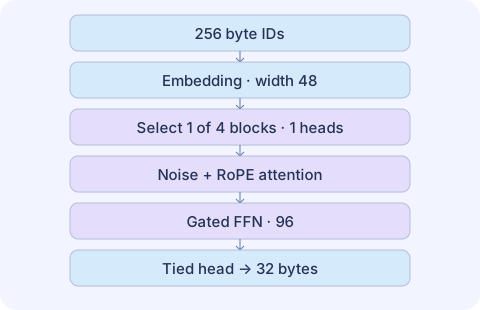
105,072 parameters · Floating-point projections
Width 48 · 4 layers · 1 heads
Index — not quality-qualified
Diagram · description · code · screen results →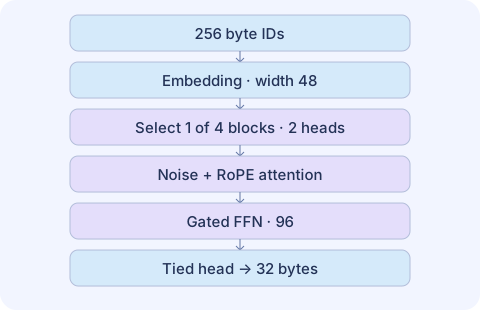
105,072 parameters · Floating-point projections
Width 48 · 4 layers · 2 heads
Index — not quality-qualified
Diagram · description · code · screen results →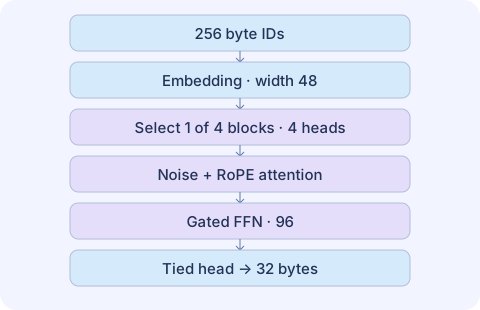
105,072 parameters · Floating-point projections
Width 48 · 4 layers · 4 heads
Index — not quality-qualified
Diagram · description · code · screen results →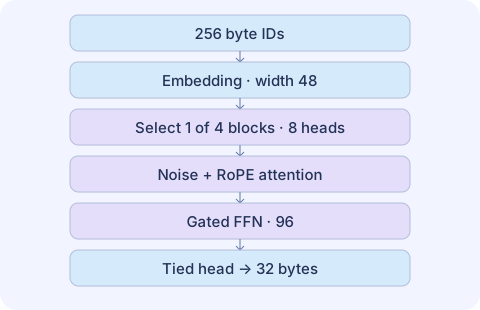
105,072 parameters · Floating-point projections
Width 48 · 4 layers · 8 heads
Index — not quality-qualified
Diagram · description · code · screen results →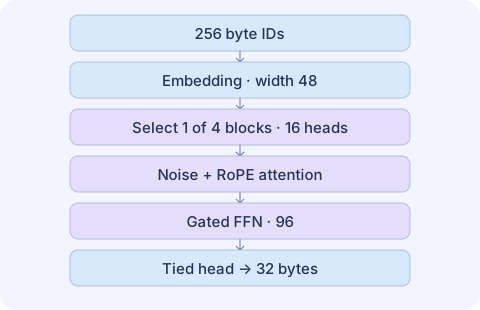
105,072 parameters · Floating-point projections
Width 48 · 4 layers · 16 heads
Index — not quality-qualified
Diagram · description · code · screen results →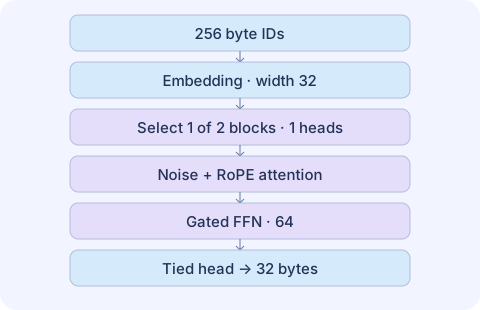
28,896 parameters · STE binary projections
Width 32 · 2 layers · 1 heads
Index — not quality-qualified
Diagram · description · code · screen results →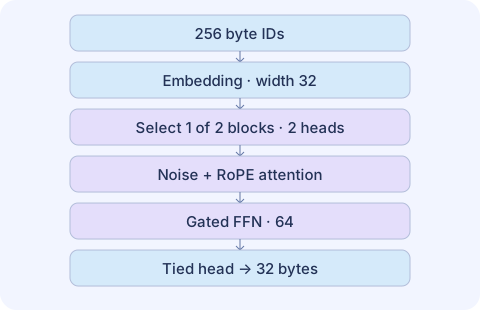
28,896 parameters · STE binary projections
Width 32 · 2 layers · 2 heads
Index — not quality-qualified
Diagram · description · code · screen results →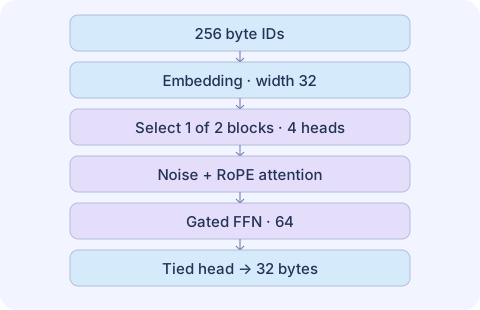
28,896 parameters · STE binary projections
Width 32 · 2 layers · 4 heads
Index — not quality-qualified
Diagram · description · code · screen results →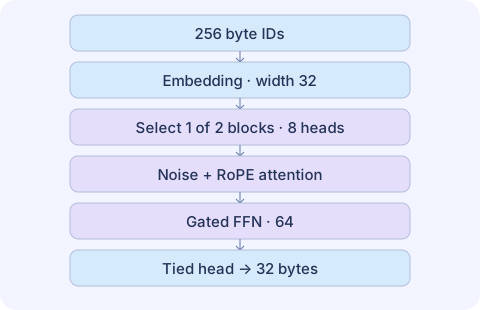
28,896 parameters · STE binary projections
Width 32 · 2 layers · 8 heads
Index — not quality-qualified
Diagram · description · code · screen results →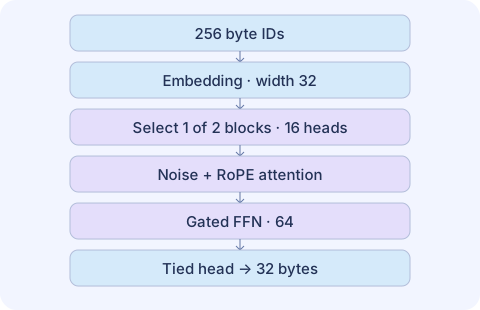
28,896 parameters · STE binary projections
Width 32 · 2 layers · 16 heads
Index — not quality-qualified
Diagram · description · code · screen results →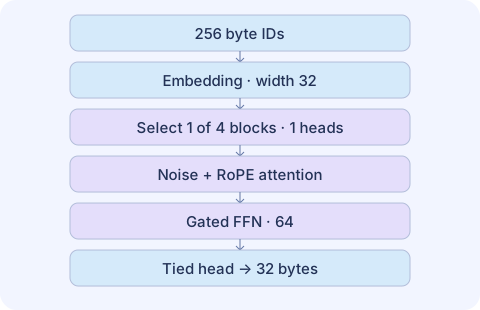
49,568 parameters · STE binary projections
Width 32 · 4 layers · 1 heads
Index — not quality-qualified
Diagram · description · code · screen results →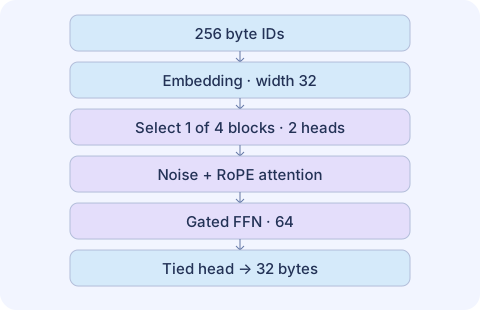
49,568 parameters · STE binary projections
Width 32 · 4 layers · 2 heads
Index — not quality-qualified
Diagram · description · code · screen results →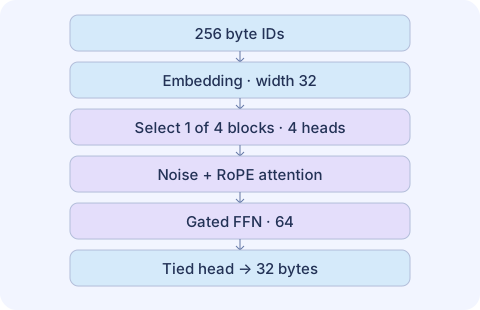
49,568 parameters · STE binary projections
Width 32 · 4 layers · 4 heads
Index — not quality-qualified
Diagram · description · code · 3-seed curves →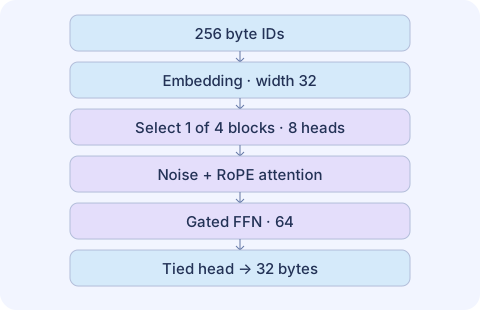
49,568 parameters · STE binary projections
Width 32 · 4 layers · 8 heads
Index — not quality-qualified
Diagram · description · code · screen results →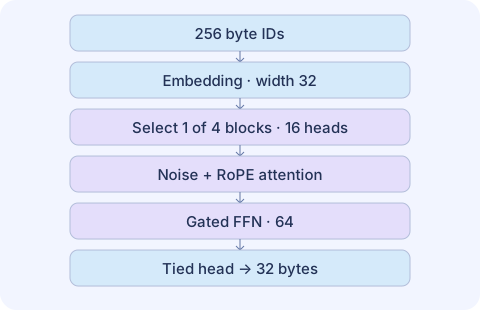
49,568 parameters · STE binary projections
Width 32 · 4 layers · 16 heads
Index — not quality-qualified
Diagram · description · code · screen results →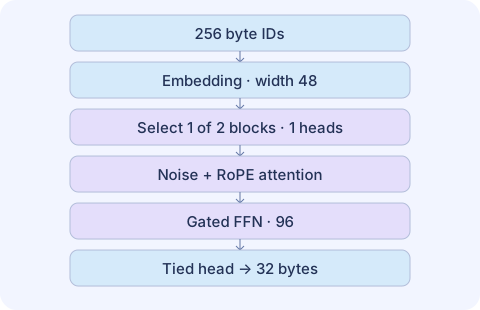
58,704 parameters · STE binary projections
Width 48 · 2 layers · 1 heads
Index — not quality-qualified
Diagram · description · code · screen results →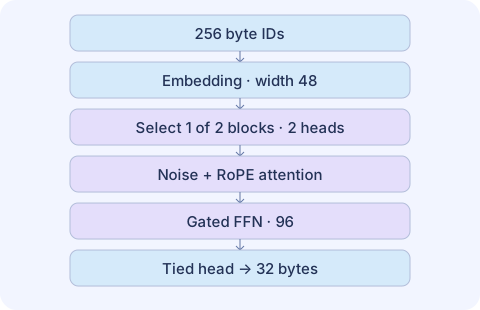
58,704 parameters · STE binary projections
Width 48 · 2 layers · 2 heads
Index — not quality-qualified
Diagram · description · code · screen results →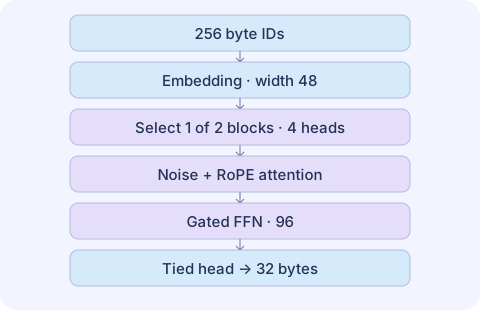
58,704 parameters · STE binary projections
Width 48 · 2 layers · 4 heads
Index — not quality-qualified
Diagram · description · code · screen results →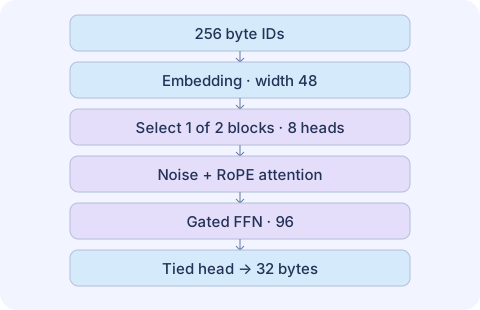
58,704 parameters · STE binary projections
Width 48 · 2 layers · 8 heads
Index — not quality-qualified
Diagram · description · code · screen results →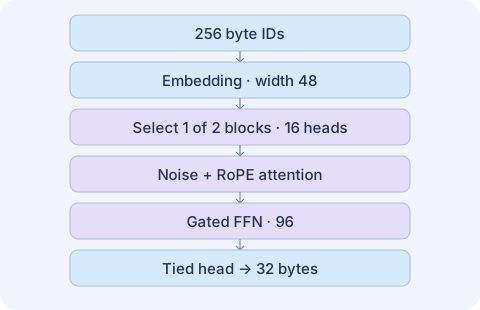
58,704 parameters · STE binary projections
Width 48 · 2 layers · 16 heads
Index — not quality-qualified
Diagram · description · code · screen results →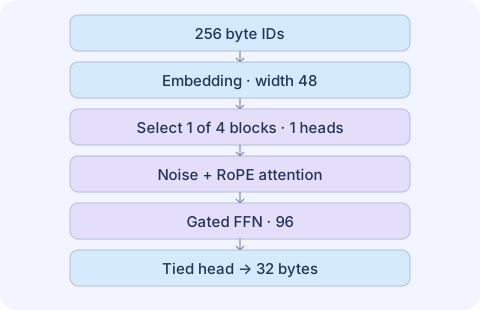
105,072 parameters · STE binary projections
Width 48 · 4 layers · 1 heads
Index — not quality-qualified
Diagram · description · code · screen results →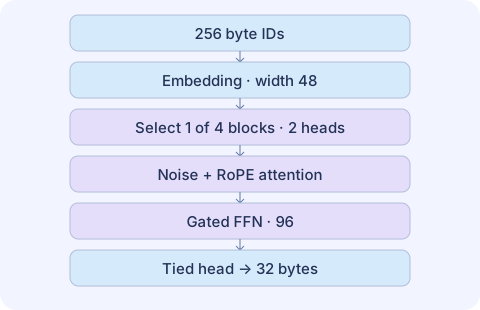
105,072 parameters · STE binary projections
Width 48 · 4 layers · 2 heads
Index — not quality-qualified
Diagram · description · code · screen results →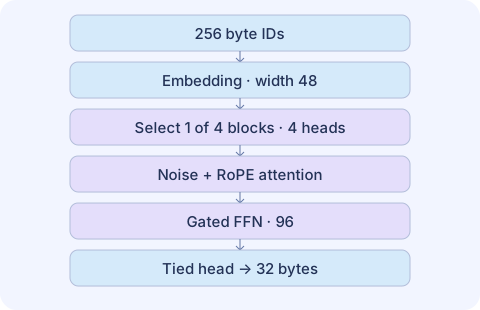
105,072 parameters · STE binary projections
Width 48 · 4 layers · 4 heads
Index — not quality-qualified
Diagram · description · code · screen results →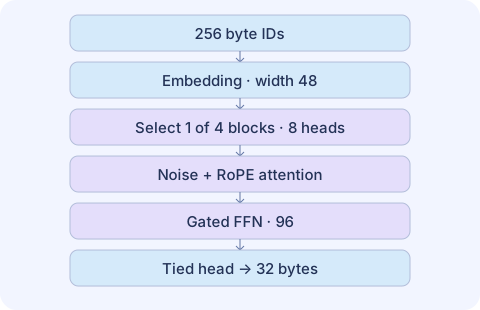
105,072 parameters · STE binary projections
Width 48 · 4 layers · 8 heads
Index — not quality-qualified
Diagram · description · code · screen results →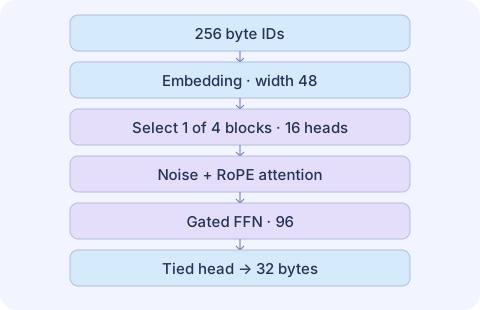
105,072 parameters · STE binary projections
Width 48 · 4 layers · 16 heads
Index — not quality-qualified
Diagram · description · code · screen results →Default: 60% measured loss, 20% training CPU time, 20% serving latency. The highest index is first; no settings changes are needed.
The shape-matched floating-point and binary conv5 pair is ranked automatically. Advanced settings are optional. This is a small pilot comparison, not a ranking of the 200 screened candidates.
For each selected group, each component equals the lowest measured value in that group divided by the model’s measured value. All three inputs are lower-is-better: mean test cross-entropy, mean training CPU seconds, and mean prefill-plus-64-decode latency. Index = 100 × weighted average of those components. Weights are normalized to sum to one. The default 60/20/20 is an analyst-selected preference, not a learned or official score.
The quality component is a numerical transform of loss, not a ratio of intelligence. An index of 100 only means best on every selected component within this tiny group. Near-equal training times contribute near-equally; trivial timing variation is not magnified to a full 0–100 range. Weight zero omits a component’s contribution; all-zero weights leave the comparison unranked.
All displayed pilot rows have 3/3 inputs. A missing input leaves the index unavailable rather than filling it with zero. No confidence interval is claimed. Three seeds and noisy CPU timings cannot establish a robust global winner. Changing group or prompt length changes the reference and can change the ordering.
Training budgets were approximately two CPU seconds, not time to matched quality. Serving measurements were not quality-matched. Expanding to all four controls introduces different sizes and inductive biases, including a small untuned position-free attention control. GPU performance, energy, financial costs and frontier capability are unmeasured and excluded. The 200 tiny screens remain unranked because their quality evidence is inadequate.
The 200-candidate screen uses 28,896–105,072 parameters, widths 32 or 48, depths 2 or 4, and a 256-byte vocabulary. These are tiny experimental models, not billions-of-parameter systems. Each register entry lists its exact dimensions and measured parameter count.
Pinned upstream planning and review stages → bounded assistant-driven adaptation → independent candidate experiments.
Paper and public vision code → experimental language adapters → AR, eight-byte semi-AR and 32-byte parallel-block families.
Four hand-reviewed controls × three seeds. FP conv5, binary conv5, binary conv3 and attention. Separate from the 200-entry register.
Five families × 40 configurations. These are a structured grid, not 200 demonstrated evolutionary descendants. All passed corrected cycle004 smoke checks and tiny-budget screening.
AR controls run all blocks with causal attention, either dense or limited to 16 positions. Diffusion-inspired variants use a noise-conditioned block and joint refinement within their configured generation group. Binary projections simulate signed weights in floating-point storage; there is no packed binary accelerator.
Requires PyTorch. This is the actual experimental adapter source, not official Sakana language-model code. It defines the models; use the research harness for training, data and checkpoints. Download models200.py · Upstream Apache-2.0 license
Archived v1 code below has a conditioning-coverage mismatch. Use corrected v2 source or a candidate’s complete file instead.
"""Experimental paper-derived DiffusionBlocks/AR/SAT/NAT CPU adapters.

Not official Sakana AR code. Equations/noise-band design follow paper2506.14202v3
and SakanaAI/DiffusionBlocks@ade0b08. Upstream Apache2license is retained separately.
All dense projection 'binary' operations emulate STE signs in FP32, not packed.
Generation takes prefixes only, never reference continuations.
"""
import math
from statistics import NormalDist
import torch
from torch import nn
from torch.nn import functional as F
N=NormalDist();PM=-1.2;PS=1.2;SMIN=.002;SMAX=80.
def cdf(s):return N.cdf((math.log(s)-PM)/PS)
def sigma(p):return math.exp(PM+PS*N.inv_cdf(p))
def boundaries(n):return [sigma(cdf(SMIN)+(cdf(SMAX)-cdf(SMIN))*i/n) for i in range(n+1)]
class Linear(nn.Linear):
    def __init__(self,a,b,binary=False):super().__init__(a,b,bias=False);self.binary=binary
    def forward(self,x):
        w=self.weight
        if self.binary:
            quant=torch.where(w>=0,1.,-1.)*w.detach().abs().mean(1,keepdim=True);w=w+(quant-w).detach()
        return F.linear(x,w)
class RMS(nn.Module):
    def __init__(self,d):super().__init__();self.weight=nn.Parameter(torch.ones(d))
    def forward(self,x):return x*torch.rsqrt(x.square().mean(-1,keepdim=True)+1e-5)*self.weight
class Block(nn.Module):
    def __init__(self,d,h,binary):
        super().__init__();self.h=h;self.d=d;self.n1=RMS(d);self.n2=RMS(d)
        self.qkv=Linear(d,3*d,binary);self.out=Linear(d,d,binary);self.up=Linear(d,2*d,binary);self.gate=Linear(d,2*d,binary);self.down=Linear(2*d,d,binary)
        self.time=nn.Linear(1,d,bias=False)
    def rope(self,x,pos):
        # Head widths2,3,4,...: rotate the even prefix; retain any odd final dim.
        k=(x.shape[-1]//2)*2
        f=10000.**(-torch.arange(0,k,2,device=x.device,dtype=x.dtype)/max(1,k));a=pos[:,None]*f
        u,v=x[...,:k:2],x[...,1:k:2];r=torch.stack((u*a.cos()-v*a.sin(),u*a.sin()+v*a.cos()),-1).flatten(-2)
        return torch.cat([r,x[...,k:]],-1)
    def forward(self,x,mask,pos,noise=None):
        if noise is not None:x=x+self.time(noise)
        b,t,d=x.shape;q,k,v=self.qkv(self.n1(x)).chunk(3,-1);q,k,v=[z.reshape(b,t,self.h,d//self.h).transpose(1,2) for z in (q,k,v)]
        q,k=self.rope(q,pos),self.rope(k,pos);a=F.scaled_dot_product_attention(q,k,v,attn_mask=mask).transpose(1,2).reshape(b,t,d)
        x=x+self.out(a);z=self.n2(x);return x+self.down(F.silu(self.gate(z))*self.up(z))
class Architecture(nn.Module):
    def __init__(self,spec):
        super().__init__();self.spec=spec;d=spec['width'];self.emb=nn.Embedding(256,d);self.norm=RMS(d)
        self.blocks=nn.ModuleList([Block(d,spec['attention_heads'],spec['binary_transformer_projections']) for _ in range(spec['depth'])]);self.diff=spec['family'].startswith('diffusionblocks');self.bands=boundaries(spec['depth'])
    def logits(self,x):return F.linear(self.norm(x),self.emb.weight)/math.sqrt(self.spec['width'])
    def forward(self,tokens):
        assert not self.diff,'Diffusion model has no ordinary AR likelihood forward'
        x=self.emb(tokens);t=tokens.shape[1];i=torch.arange(t);mask=i[:,None]>=i[None,:]
        if self.spec['family']=='ar_local16':mask&=(i[:,None]-i[None,:]<16)
        for block in self.blocks:x=block(x,mask,i)
        return self.logits(x)
    def training_mask(self,t):
        # x_i is the previous clean token for target y_i. Clean keys <=groupstart
        # are permitted; noisy keys only from the current generated group.
        k=self.spec['generation_block_size'];i=torch.arange(t);group=(i//k)*k
        mask=torch.zeros((2*t,2*t),dtype=torch.bool);mask[:t,:t]=i[:,None]>=i[None,:]
        mask[t:,:t]=i[None,:]<=group[:,None];mask[t:,t:]=(i[None,:]//k)==(i[:,None]//k)
        return mask
    def denoise(self,clean,z,sig,block,training=True):
        b,t,d=z.shape;past=self.emb(clean);sd=.5
        cin=torch.rsqrt(sig.square()+sd**2);cout=sig*sd*cin;cskip=sd**2/(sig.square()+sd**2)
        x=torch.cat([past,z*cin[:,None,None]],1);n=past.shape[1]
        cond=x.new_zeros((b,n+t,1));cond[:,n:]=(.25*sig.log())[:,None,None]
        if training:mask=self.training_mask(t);pos=torch.cat([torch.arange(n),torch.arange(t)+1])
        else:
            mask=torch.zeros((n+t,n+t),dtype=torch.bool);mask[:n,:n]=torch.ones((n,n),dtype=torch.bool).tril();mask[n:,:]=True;pos=torch.arange(n+t)
        hidden=self.blocks[block](x,mask,pos,cond)[:,n:]
        denoised=hidden*cout[:,None,None]+z*cskip[:,None,None]
        return self.logits(denoised)
    def loss(self,batch,g):
        x,y=batch[:,:-1],batch[:,1:]
        if not self.diff:return F.cross_entropy(self(x).flatten(0,1),y.flatten()),{'active_blocks':len(self.blocks)}
        interval=int(torch.randint(len(self.blocks),(1,),generator=g));lo,hi=self.bands[interval:interval+2]
        delta=math.log(hi)-math.log(lo);lo=max(SMIN,math.exp(math.log(lo)-.1*delta));hi=min(SMAX,math.exp(math.log(hi)+.1*delta))
        u=torch.rand(batch.shape[0],generator=g).tolist();sig=torch.tensor([sigma(cdf(lo)+(cdf(hi)-cdf(lo))*v) for v in u])
        target=F.normalize(self.emb(y),dim=-1);z=target+sig[:,None,None]*torch.randn(target.shape,generator=g)
        block=len(self.blocks)-1-interval;logits=self.denoise(x,z,sig,block,True)
        ce=F.cross_entropy(logits.flatten(0,1),y.flatten(),reduction='none').reshape(y.shape)
        weight=(sig.square()+.25)/(sig*.5).square()
        return (ce*weight[:,None]).mean(),{'active_blocks':1,'block':block,'objective':'weighted denoising CE, not AR NLL'}
    @torch.inference_mode()
    def generate(self,prefix,new_tokens,seed=1,passes=4):
        self.eval();g=torch.Generator().manual_seed(seed);tokens=prefix.clone();calls=0;generated=0
        while generated<new_tokens:
            if not self.diff:
                logits=self(tokens)[:,-1];out=logits.argmax(-1)[:,None];calls+=1
            else:
                k=min(self.spec['generation_block_size'],new_tokens-generated);b=tokens.shape[0];d=self.spec['width']
                z=torch.randn((b,k,d),generator=g)*math.sqrt(1+SMAX**2)
                schedule=[sigma(cdf(SMIN)+(cdf(SMAX)-cdf(SMIN))*i/(passes-1)) for i in reversed(range(passes))]
                for i,s in enumerate(schedule):
                    interval=min(len(self.blocks)-1,max(0,sum(s>=v for v in self.bands)-1));block=len(self.blocks)-1-interval
                    logits=self.denoise(tokens,z,torch.full((b,),s),block,False);calls+=1
                    if i+1<len(schedule):
                        target=F.linear(logits.softmax(-1),F.normalize(self.emb.weight,dim=-1).t());z=z+(schedule[i+1]-s)*(z-target)/s
                out=logits.argmax(-1)
            tokens=torch.cat([tokens,out],1);generated+=out.shape[1]
        return {'tokens':tokens[:,prefix.shape[1]:],'model_calls':calls,'generation_block_size':self.spec['generation_block_size'],'passes_per_group':passes if self.diff else 1,'cache':'none; full-prefix execution charged'}
This optional demo runs the 17,632-parameter floating-point conv5, seed 17 from the separate matched pilot. It has width 32, one depthwise causal convolution with kernel five, layer normalization, a SiLU projection, residual connection and a 256-byte output head. It is a very small, briefly trained byte model, not a chatbot. Repetition or poor text is expected.
No model has run yet.
Download plain-array checkpoint · Single-file JavaScript inference engine · PyTorch equivalence check
Verification: three prefix cases, 48 generated bytes matched exactly, maximum logit difference 0.000001321 against PyTorch FP32. This checks the engine, not useful model quality. Hugging Face and GitHub release links will appear only after publication is confirmed. Download the verified single-file Python inference runner for the 200-family adapters. It requires PyTorch and a matching model-only checkpoint. Read the screen and confirmation ledger.
The binary-projection convolution did not beat its shape-matched floating-point control.
Four small models × three seeds = 12 completed training jobs on real WikiText-2 byte data. Lower cross-entropy is better; the floating-point conv5 control won in all three paired seeds. These descriptive results do not establish broad architectural superiority.
Fresh non-overlapping validation and test windows were hash-checked; exact 64-byte scored blocks found in training were excluded. Public source splits had been used in prior research, so this is not a claim of previously untouched or semantically uncontaminated data.
All 12 saved checkpoints reproduced their test-window losses. Cached-versus-full logits and future-token causality were checked. A separate fixed-update replay reproduced one job bitwise; CPU-time-budget reruns can execute different numbers of updates.
Binary projection weights were simulated using floating-point storage. No packed binary kernel or binary runtime speedup was demonstrated. The attention control was small, untuned and position-free. CPU microbenchmarks were not quality-matched, and no GPU, energy, production-cost, frontier-intelligence or 600B-scale conclusion follows.
This used adapted upstream ASI-Arch stages with a bounded coordinator, not a reproduction of the original large search.
Predeclare quality targets. Record time to target and quality at fixed budgets, actual peak memory, and realistic serving workloads. If a target is not reached, report that explicitly.
Training and serving are different questions. Prefer quality–time–memory Pareto comparisons. CPU seconds are not joules or money; quality scores are not a ratio-scale measure of intelligence.
Do not rank diffusion denoising loss against ordinary autoregressive perplexity. Define a shared sampled conditional predictive logscore, exclude target embeddings from inputs, and disclose sampling passes and their cost.
DiffusionBlocks’ public code is a vision-classification implementation, not released autoregressive training code. The proposed language-model adaptations must document departures from the paper: four training blocks, noise partitioning and conditioning, clean-past/noisy-target masks, and denoising steps. Four blocks is a paper setting, not a proven universal optimum.
This programme is inspired by ASI-Arch and DiffusionBlocks. It is not an official product of either research team. The separate 105-candidate ASI-Arch explorer retains its original public-source analysis; those 105 records are not merged into these 200 registered specifications.