Calibrated AA-index scale, not IQ or percentage accuracy. Configurations and dates differ across sources. Missing scores are unknown, never zero. ± shows comparison spread from source disagreement and calibration error. It is not a formal standard error or confidence interval; nearby ranks should be read with this spread.
Coverage labels: Full means every scoring source contributed; Partial means two or more, but not all; One source means just one; No assessed score means no usable score. Arena preliminary comes from Arena. Coverage is not confidence.
Both appear in the same combined ranking. Provisional marks a composite based on specialist evidence; open a model to see its published measurements, exact variants and calibration. Source coverage and comparison spread remain visible.
View selected models ↓Select up to 4 models to compare ↓ · Column headings reorder the table
Compare
Rank
No models match. Try a broader search or coverage filter.
Selected models
Rank within this selection uses the same Atlas composite as the main leaderboard. It is not a direct measure of intelligence; close scores may overlap.
PUBLISHER LEADERBOARD
LiveBench 2.0 official scores
This publisher-only ranking is separate from the Model Atlas composite above. Benchmark release: 6 Nov 2026. Publisher update: 11 Nov 2026. Verified snapshot: 22 Nov 2026, 15:03 UTC.
#1 Gemini 4 Neon (xhigh): 87.4
#2 tied Claude Fable 5.2 (xhigh): 84.9
#2 tied GPT-6.2 Astra (max): 84.9
#4 GPT-6 Astra (max): 84.3
Show all 39 tested variants
Ranks share a place when the published one-decimal scores are equal. This is a verified snapshot, not a new benchmark release.
LiveBench 2.0 overall public scores on the 0–100 scale
Picker options and measured benchmark variants are linked below. GPT-6 Pro has its own ranked evidence from explicitly Pro-labelled variants; other settings retain their own matching status.
02 / HOW TO READ IT
A fairer merge. Not a final verdict.
01
Normalize, then combine
The original five-source fit establishes the common AA-index scale. WeirdML, GameBench, KingBench and ModelDial are each mapped to that fixed reference using shared releases with at least two baseline sources. Each available benchmark then receives one equal vote. The result is an Atlas comparison, not an official AA score.
02
Keep source influence balanced
AA combines its global index (50%) and domains (50%). LiveBench uses suites, not its overlapping overall score. Within the original sources, metrics use estimated precision weights. Vals and Epoch supply composite indices. Each added benchmark contributes its overall result once; task subsets, repeated effort settings, runtime and token counts do not add votes.
03
Show the gaps
Missing results are omitted, not assigned zero. GPT-6 Pro and GLM-5.4 are marked provisional because their current coverage comes from specialist benchmarks. Overall scores and domain scores can overlap, so distinct source votes are not statistically independent.
04
Compare with care
These are release-level aggregates with mixed effort settings. Comparison spread includes source disagreement and bridge prediction error; it is not a formal confidence interval. The model panel shows source omission, mapping and approximate precision-weighted sensitivity checks. Cost, speed and context size are excluded.
This page reads the latest published SG MCP ranking and checks for updates every minute while open. The source cards identify current inputs, unchanged publisher data, cache, and historical fallbacks separately. Publisher, evaluation, check and retrieval dates can differ. Retrieval dates are not new test dates. No tracker credentials are embedded here.
ADDITIONAL EVIDENCE · CONTEXT ONLY
Seven specialist benchmark sources
These benchmarks help explain specific skills. None changes the Model Atlas composite, adds a source vote, or fills a missing score. Publisher links checked on 23 Nov 2026; that is not a test date.
SOFTWARE REPAIR
SWE-bench Verified
Percentage of 500 human-filtered repository issues resolved by an agent’s patch.
Compare the same suite and agent harness; do not count the same coding tasks again if an existing source uses them.
Before including a source in the composite: pin the benchmark and harness, verify the exact model version and effort settings, check task overlap, and publish enough matched coverage to reproduce the calibration. Download this source directory (JSON) ↗
Agent Arena source detail ·
The current publisher series uses a different methodology from older Arena results. The exact published settings can differ from other benchmarks. Cost is shown only if supplied, on the publisher’s basis.
Publisher rank
Exact variant
Arena index
Index interval
Sessions
Preliminary status
Publisher cost
04 / RELEASE REFERENCE
Gemini 4 Neon: the source, alongside the scores.
Independent benchmark results
This section was written against the 6 November 2026 LiveBench release. The live table above now uses newer LiveBench data, so the figures here may be out of date.
LiveBench 2.0: #1 · 87.4 overall. Tested as xhigh according to the publisher’s model metadata. Release 6 November 2026; current publisher snapshot retrieved 20 November. Leaderboard ↗ · Suite results ↗
Artificial Analysis: #3 at launch · 61.4 Intelligence Index points. Gemini 4 Neon (xhigh), reported 18 November 2026. Model results ↗
These are separate leaderboards with different tasks and scoring methods. Model Atlas now includes this 39-model LiveBench snapshot. Its seven suites contribute one calibrated source vote; the headline 87.4 overall is not counted again. Benchmark release 6 November; retrieved 20 November.
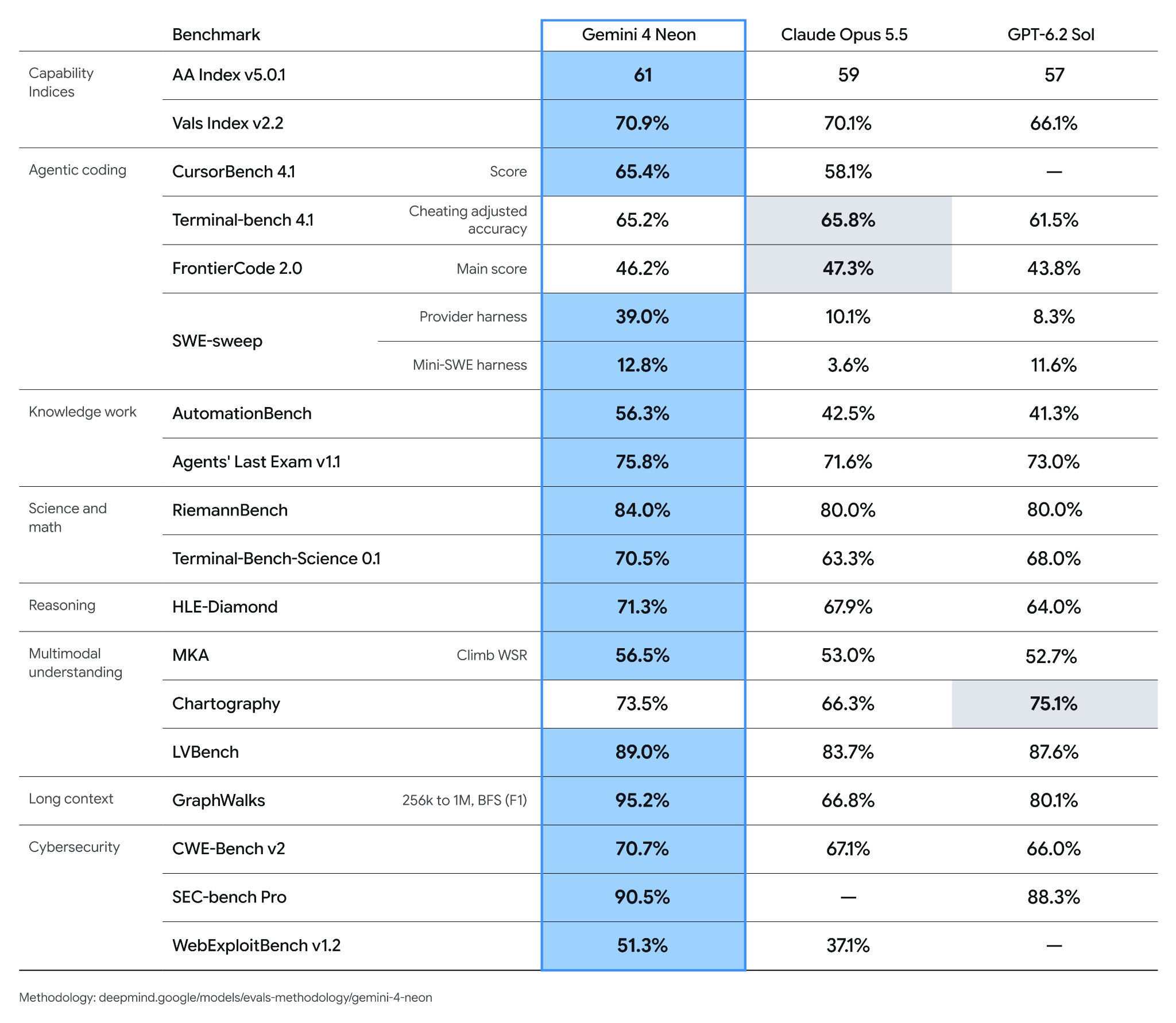
Publisher benchmark compilation · November 2026
This user-supplied chart accompanies a Google DeepMind release post. DeepMind’s linked methodology describes a mixture of its own evaluations and results from external benchmark providers. It is reference material, not an independently reproduced test or an additional vote in the Model Atlas composite.
Settings matter: Gemini generally uses its highest thinking setting, while some comparisons use different harnesses or published competitor results. In SWE-sweep, the provider-harness and Mini-SWE rows are separate setups, not interchangeable measurements. Treat the chart as a guide to tasks worth testing, not proof of one universal winner.
Reference chart credited to Google DeepMind, supplied by the site owner. Open the image for full size. Methodology checked 19 November 2026; the X post itself was inaccessible to automated retrieval. Personal phone-interface content from the accompanying screenshot is not published. This static reference does not change the live leaderboard or its refresh schedule.RELEASE REFERENCE · 23 NOV 2026 · PROVISIONAL COMPOSITE
GLM-5.4: text and image evidence
Loop Transformer (Z.ai’s description). GLM-5.4 launched on 23 Nov 2026 with 28 shared middle layers run twice, not two independent copies of those weights. It takes images as input for visual coding. Z.ai listed its Coding Plan, ZCode and Chat at launch; general API access and open weights were described as forthcoming.
TEXT AND CODING · PUBLISHED RESULTS
Early independent tests
ModelDial scored GLM-5.4 at max effort 47.6/100 (29th of 55) on its coding suite: backend 45.9, frontend 56.7 and knowledge/reasoning 55.0. Its 26.0 for visual aesthetics rates the finished interface, not image understanding. Task definitions ↗
AICodeKing reported 7th in KingBench 4 with early access, on the reviewer’s own coding tasks. FeelFish recorded GLM-5.4 meeting its brief checklist in 2 of 3 Chinese fiction prompts with writing aids; that is not a general text or writing-quality score.
IMAGE INPUT · VERIFIED BENCHMARK COVERAGE PENDING
Vision and visual coding
Z.ai confirms that GLM-5.4 can read images. We found no verified image-input benchmark score for this exact release in the sources checked. Interface aesthetics, image generation and image understanding measure different things.
RESEARCH · SEPARATE MODEL
What the launch chart measures
The numerical chart in Z.ai’s post is a controlled comparison on a 30B research model after long-context tuning. It is not a benchmark of the GLM-5.4 release and is not used as one here.
ATLAS STATUS · RANKED
Included in the main composite
Loading its published composite…
ModelDial Coding v2 and KingBench 4 each contribute one calibrated vote. KingBench is explicitly an early-access Max preview with mixed judges and clarified-prompt reruns. Open the raw scores and calibration ↗
SPECIALIST EVIDENCE · 23 NOV 2026 · ONE COMPOSITE SOURCE
GLM-5.4 on KingBench 4
One reviewer’s early-access coding evaluation. The entries below separate quality from runtime and tool behavior. They are views of a small set of runs, not nine independent benchmarks.
01 · QUALITY
Overall performance
AICodeKing reported GLM-5.4 in 7th of 19, with 33.2/60 on KingBench 4. The displayed total includes reruns with clarified prompts, not a strictly identical-prompt comparison. The preview total supplies one calibrated contribution to the main Atlas ranking; 7th is its original KingBench position. Published chart ↗
02 · QUALITY SUBSET
App tasks
The public chart reports 20.6/30, 8th. The app-task subtotal reuses tasks from the overall evaluation. Published chart ↗
03 · QUALITY SUBSET
Systems tasks
The supplied chart reports 6.2/20, tied 9th, from tasks 01 and 02. The same-prompt subtotal was 4.8. This subset is already inside the overall total and adds no separate vote.
04 · QUALITY BREAKDOWN
GLM-5.4 versus GLM-5.3
The public chart compares six tasks. The paired breakdown comes from the overall test, not six new trials. Published chart ↗
05 · RUNTIME
Model turns and elapsed time
The reviewer reported 1,128 vs 244 steps and 431 vs 109 minutes for the GLM-5.4 and Gemini 4 Neon runs. The runs used different settings; this is not a matched decoding-speed comparison.
06 · RESOURCE USE
Reasoning tokens
The reviewer reported about 1.04 million vs 70,000 reasoning tokens in total for GLM-5.4 and Neon. These are run totals, not a per-task table or a cost estimate.
07 · TOOL BEHAVIOR
Tool-error recovery
The reviewer reported a working retry after 66% of GLM-5.4’s failed tool calls. This is conditional on a tool call failing in that evaluation, not a task success rate. Published chart ↗
08 · REASONING TRACE
Steps with reasoning
The reviewer reported near-zero reasoning on under 1% of GLM-5.4’s steps. The trace records activity, not whether the reasoning was correct. Published chart ↗
09 · EFFORT AND TIME
Effort settings and short tasks
The reviewer reported roughly 1.5× as much reasoning at Max as at High. The supplied chart reports six-task totals of 25.2 Low, 24.1 Medium, 28.8 High and 31.8 Max with the original prompts. The clarified reruns raise Max to 33.2. The five-task microbench is separate and adds no composite vote.
AICodeKing’s public results ↗ · Original review ↗. Atlas keeps one capability ranking. The six-task total contributes once, using the supplied chart and its explicit preview/settings caveats; subsets, runtime, token use and tool traces add no votes. The original-prompt 31.8/60 appears as a sensitivity check. The supplied overall chart bears an “Internal only (NDA)” footer, preserved in the evidence provenance; these image files are not described as independently verified public releases. These coding results do not establish image-input understanding.
One combined index: GLM-5.4 uses its published ModelDial score and the supplied KingBench preview total, each mapped through shared releases to the original five-source reference. GPT-6 Pro uses explicitly Pro-labelled WeirdML and GameBench results. The main table, downloads and model panels all read the same published scores. Open either model to inspect coefficients, anchors, raw scores and sensitivity checks.